Jump to a question in this guide
- Why is an electric sauna a connected room-and-heater system?
- What do the heating elements, stones and casing do?
- How does heat move from the heater into air and surfaces?
- How do a stone-heater sauna and an infrared cabin differ?
- Why can ventilation arrangements differ between electric sauna rooms?
- How do the thermostat, timer and high-limit protection differ?
- Why do the enclosure, door and room materials affect response?
- Where does moisture go during use and drying?
- What belongs in the electrical and installation enquiry?
- How do guards, benches, access and nearby objects affect ownership?
- What can slow warming or a changed heat pattern mean?
- How should stone care, cleaning and service responsibilities be set?
- Which identity, recall and change records belong in the file?
- How should you compare a repair with an altered room or replacement?
- How would a fictional owner resolve slow warming after a room change?
- What should a useful sauna handover make understandable?
- Elements add heat, stones store and release it, and the room and air route shape the complete response.
- Thermostat, timer and high-limit protection have different jobs; a reset or display is not a whole-system finding.
- Mechanical and gravity ventilation schemes differ; actual model, room, sensor and local requirements determine the arrangement.
- Heater work, enclosure/air assessment and individual health suitability remain separate; exact model identity also matters for recall checks.
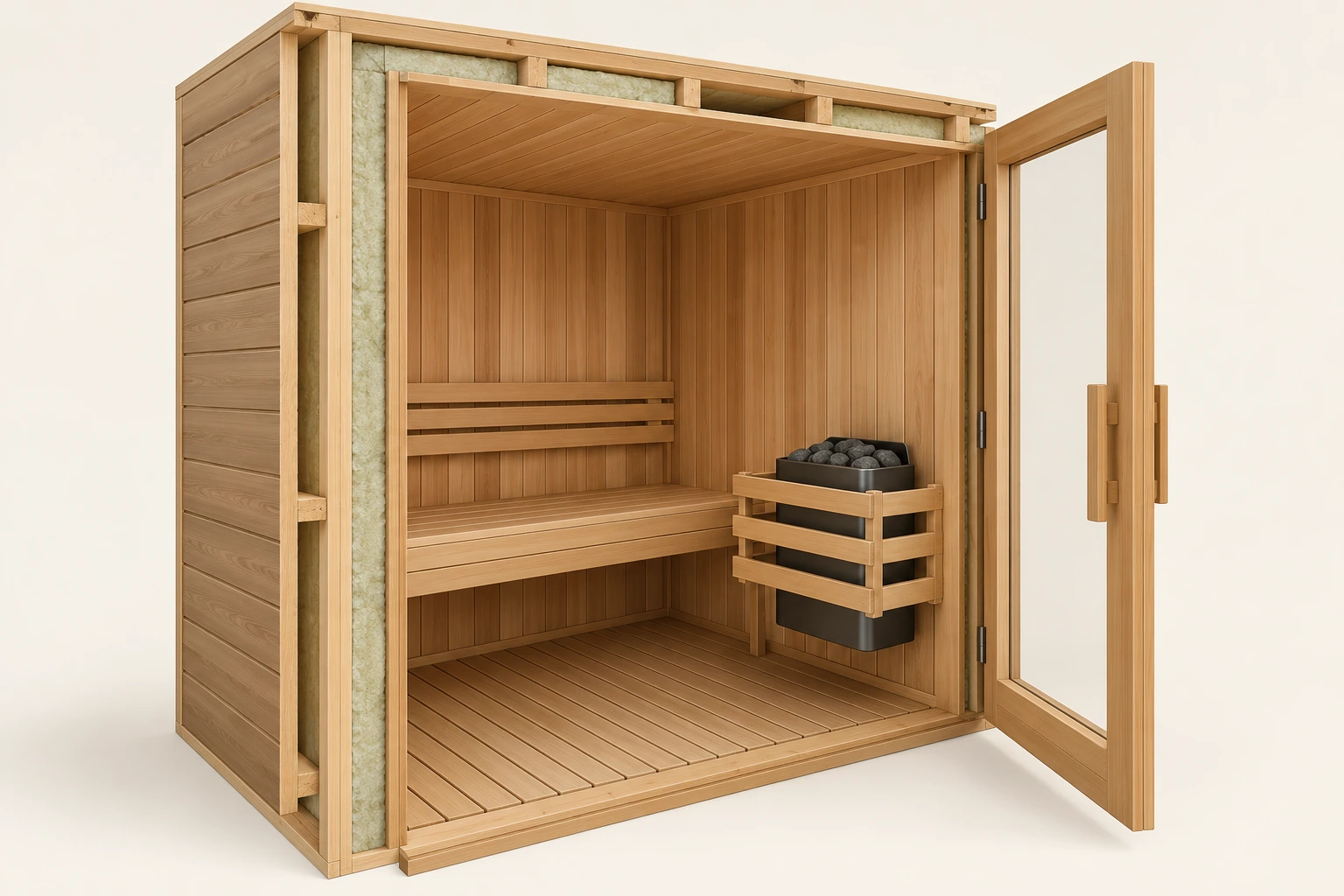
The heater warms a room made of surfaces, benches and an enclosure, rather than an empty volume of air alone. Those parts store and lose heat differently, while the actual air-exchange route needs its own model- and room-specific explanation.
About this illustration
No ventilation route, electrical connection, sensor location, installation dimension, guard approval or safe-use clearance is shown. This is a conceptual teaching model, not an assessment of your home.
8 picture lessons appear beside the questions in this guide. Use them to understand the explanation, then consider what it means for your home.
Why is an electric sauna a connected room-and-heater system?
A traditional electric sauna combines a heater, stones, enclosed room, air routes and controls. Electrical elements add heat; stones absorb and release it; moving air and surrounding surfaces exchange that heat with the room. The enclosure, door, benches and ventilation influence the resulting conditions. A heater that turns on is therefore only one part of understanding the installed sauna.
This guide follows an electric stone-heater room. Infrared cabins and fuel-fired saunas have different equipment and instructions. Do not pour water onto an infrared panel or transfer a wood-burning ventilation arrangement into an electric room because both are called a sauna. Identify the actual product before use, and obtain appropriate instruction and assessment when the history, installation or condition is uncertain.
The main mechanism example is Harvia’s named KIP manual, printed 02052023/Y05-0623, with distinct heater and controller variants. Its English body and two relevant source diagrams were read completely; the retained French remainder is not independently adopted here. Current manufacturer air guidance updated January 29, 2026 and a separate stones explanation add functional context. These do not establish one current Canadian construction or electrical rule for every sauna.
The room picture introduces the parts without supplying vent locations, sensor placement or installation dimensions. The native diagrams explain heat, air, moisture and control as separate connected routes. They are conceptual teaching aids, not a layout to build or an approval of an existing room. An appropriate installer, electrical professional and other relevant building specialists must connect the actual equipment and enclosure to applicable local requirements.
Why is a sauna a connected room-and-heater system?
The heater warms a room made of surfaces, benches and an enclosure, rather than an empty volume of air alone. Those parts store and lose heat differently, while the actual air-exchange route needs its own model- and room-specific explanation.
Numbers identify the parts explained below.
- Heater and stones
Add, receive and release heat under the actual design.
- Bench and lining
Room surfaces also exchange and store heat.
- Cut enclosure layer
The picture separates lining and a pale layer without specifying a buildable assembly.
- Guard and door
Access components are visible but dimensions and compliance are unknown.
What does this illustration leave out?
No ventilation route, electrical connection, sensor location, installation dimension, guard approval or safe-use clearance is shown. This illustration explains an idea. It is not an installation guide.
Why is a sauna a connected room-and-heater system?
Explore this with HomeAI ↗Opens an editable question. Nothing is sent until you choose to send it.What do the heating elements, stones and casing do?
An electric heating element turns electrical input into heat. In a stone heater, the element region and stones share the heater’s designed space. The stones receive heat and release it over time, while air can move through the intended openings and gaps. The casing and supports organize these parts. A heap of decorative stones is not automatically a functioning version of that arrangement.
Harvia’s parts drawing distinguishes elements, stone compartment, casing and controls. The conceptual cutaway makes those jobs visible without showing an owner-removable access panel. The actual heater must remain complete and used according to its instructions. Never touch an element, open the electrical enclosure or operate exposed parts to demonstrate the lesson. A transparent teaching illustration does not describe a safe product condition.
Stone compatibility, support and arrangement are product-specific. The manufacturer’s stones explanation says spaces and air circulation matter, and that condition can change with use. It does not justify selecting any attractive rock, compressing a dense mound or using an illustration as a loading pattern. Obtain the correct product instruction and appropriate maintenance help rather than experimenting with stone material or moving hot stones.
Ask the provider to identify the actual heater, its required stone system and the service arrangement for their condition. A service note should say what was assessed or changed, not merely “stones done.” Element condition, control operation, room ventilation and the enclosure remain different questions. Replacing a consumable or visible material does not silently assess the entire installed sauna.
How do heating elements, stones and air exchange heat?
Electric elements add heat, the stones absorb and release it, and air can move through the spaces around the stone-and-element region. The transparent section separates these jobs; it does not show a heater ready to operate with its parts exposed.
Numbers identify the parts explained below.
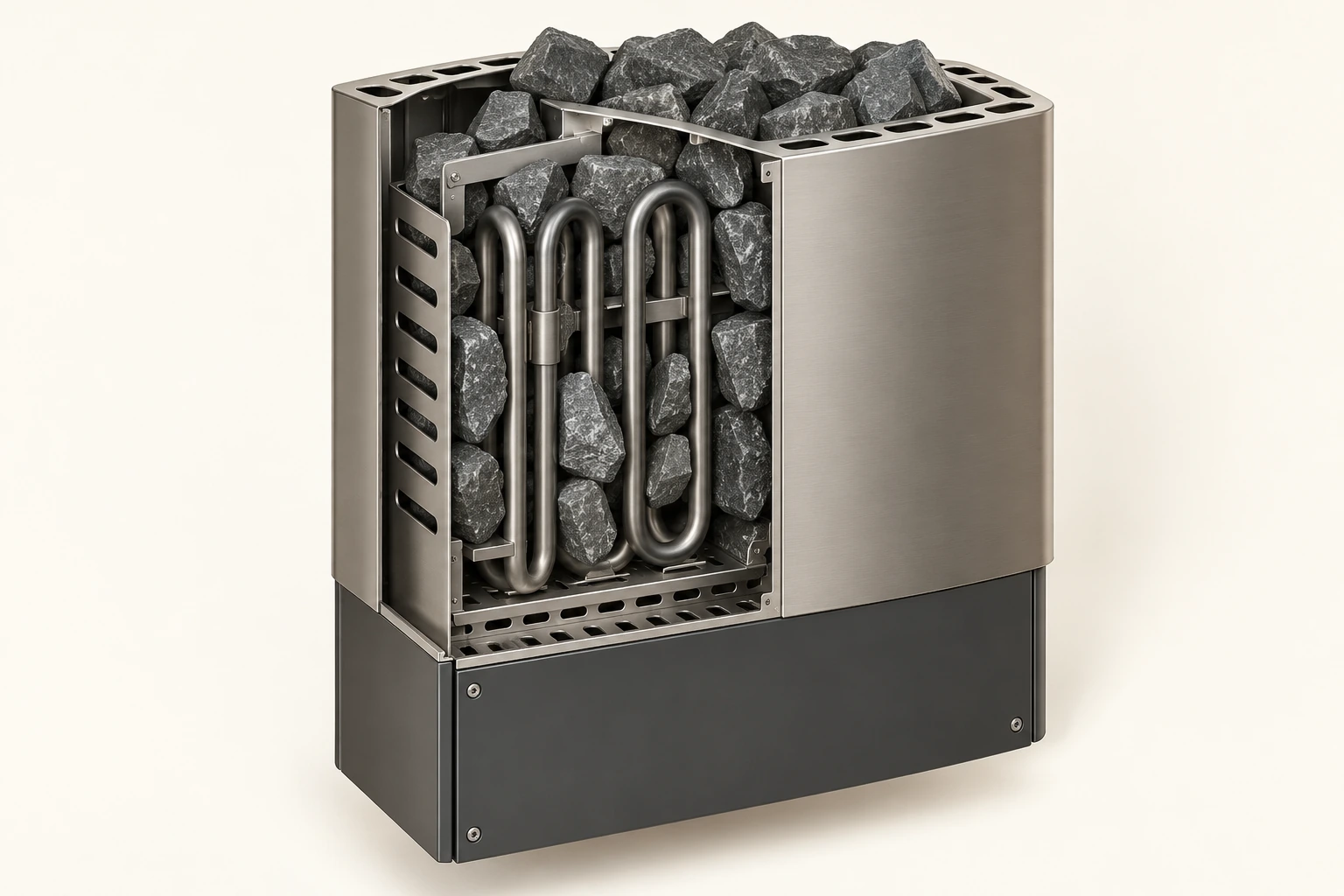
- Tubular elements
The heat-producing component region is exposed only by the conceptual cut plane.
- Stone compartment
Supported stones receive and release heat.
- Spaces
Visible gaps explain the air-path question without prescribing a loading pattern.
- Closed lower box
No wiring, terminal, reset procedure or service access is shown.
What does this illustration leave out?
Conceptual arrangement, not a stone-loading pattern, approved material, measured heat path, exposed-element test, disassembly or installation instruction. This illustration explains an idea. It is not an installation guide.
How do heating elements, stones and air exchange heat?
Explore this with HomeAI ↗Opens an editable question. Nothing is sent until you choose to send it.How does heat move from the heater into air and surfaces?
Electrical input adds heat at the elements. Stones and heater surfaces receive and release heat, air carries some heat through the room, and surrounding surfaces exchange heat too. A bench or wall can continue warming while the air at a control sensor has already changed. That is why a single displayed value does not describe every surface or every occupied position.
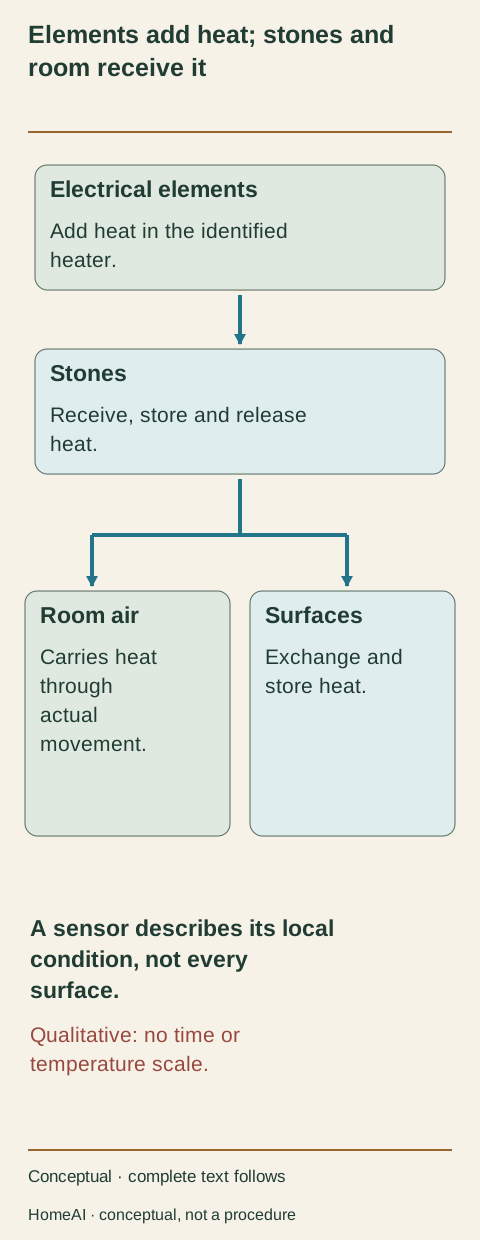
The portrait energy diagram separates heat production, stone storage and delivery to the room. Its arrows are qualitative, without a time or temperature scale. It does not promise a warm-up duration or a particular person’s experience. The actual model’s capacity, room construction, controls and air arrangement must be considered together. A product name or advertising phrase cannot fill those missing details.
Where the exact stone-heater instructions permit water use, water reaching hot stones can become vapour and change the room experience. This guide gives no pouring quantity, water additive, frequency or use recipe. The permission belongs to the actual complete product and instructions, not the broad word “electric.” Stones, decorative panels and infrared equipment cannot be treated as interchangeable receiving surfaces.
Do not use a hand held above the heater, a splash or a longer heating run as a diagnostic experiment. The retained manual contains operational and first-heating procedures that are not copied here. If heat, smell, control response or another condition is unexpected, stop relying on the system and obtain the appropriate assistance. Visible activity is not a measurement of complete installed performance.
Elements add heat; stones and room receive it
Elements produce heat, stones store and release it, and room air and surfaces receive heat through the connected arrangement.
Numbers identify the parts explained below.
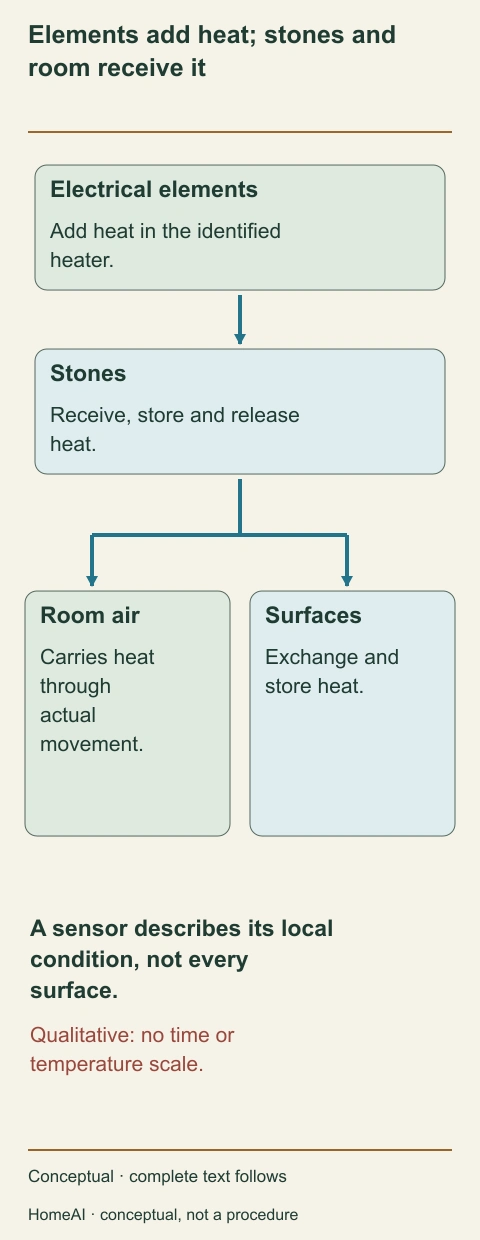
- Elements
Turn electrical input into heat.
- Stones
Receive, store and release heat.
- Room air
Carries heat through its actual movement.
- Room surfaces
Exchange and store heat; response need not match one sensor.
What does this illustration leave out?
Qualitative only; no time, temperature, output, water-use quantity or performance promise. This illustration explains an idea. It is not an installation guide.
Which actual heater, stone system and room were assessed together?
Explore this with HomeAI ↗Opens an editable question. Nothing is sent until you choose to send it.Elements add heat; stones and room receive it
Elements produce heat, stones store and release it, and room air and surfaces receive heat through the connected arrangement.
- Elements
- Turn electrical input into heat.
- Stones
- Receive, store and release heat.
- Room air
- Carries heat through its actual movement.
- Room surfaces
- Exchange and store heat; response need not match one sensor.
Figure scope: Qualitative only; no time, temperature, output, water-use quantity or performance promise.
A useful question: Which actual heater, stone system and room were assessed together?
Full wording shown in this figure
- Elements add heat; stones and
- room receive it
- Electrical elements
- Add heat in the identified
- heater.
- Stones
- Receive, store and release
- heat.
- Room air
- Carries heat
- through
- actual
- movement.
- Surfaces
- Exchange and
- store heat.
- A sensor describes its local
- condition, not every
- surface.
- Qualitative: no time or
- temperature scale.
- Conceptual · complete text follows
- HomeAI · conceptual, not a procedure
How do a stone-heater sauna and an infrared cabin differ?
A stone-heater sauna supplies heat through its element-and-stone arrangement and the connected room. An infrared cabin uses a different heating-panel arrangement and product instructions. A room label, timber lining or familiar bench cannot establish which system is present. Identify heater or panel models and controller together, including any later replacement, before relying on inherited use instructions.
The distinction matters for maintenance, controls and permitted water use. A bucket supplied with an older room does not authorize water on a different later panel. A new controller may not establish compatibility with an inherited heater. Ask the responsible provider to reconcile the actual product combinations and retain their original manuals instead of relying on one generic sauna leaflet.
Health Canada’s September 17, 2026 recallRA-82120 concerns exact named sauna and infrared-kit products whose affected infrared panels can overheat following a short circuit. It is not a recall of every sauna or the KIP example used here. Exact affected consumers must follow the notice’s stop-use and contact instructions; the presence of another brand does not constitute a fresh recall clearance.
This is a functional and ownership guide, not a comparison of health benefits. It supplies no treatment, detoxification, clinical benefit, safe personal temperature or duration. Individual suitability requires appropriate health advice when relevant. Technical equipment readiness and a particular person’s use decision are different questions; neither can be answered by a generated room picture or a seller’s experience.
Why can ventilation arrangements differ between electric sauna rooms?
Ventilation brings air into the room and gives it an intended route out. The complete arrangement includes the source of incoming air, movement through the room, the receiving exhaust route and any separate drying function. A grille is an opening, not proof that air is moving as intended. An extractor elsewhere in the home does not automatically identify this room’s ventilation scheme.
Harvia’s January 2026 support page distinguishes mechanical exhaust ventilation from gravity ventilation and describes different supply arrangements for those schemes. It also warns that incoming air can cool a temperature sensor and disturb its reading. That relationship is useful: air-route design and temperature control interact. It is not permission to relocate an inlet or sensor according to a generic room sketch.
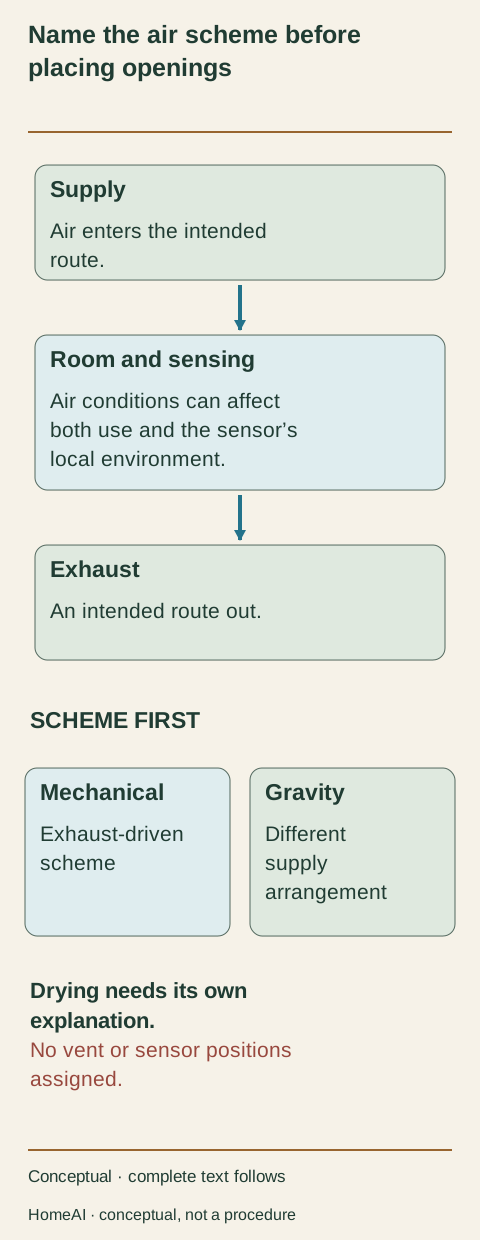
The native diagram gives the room, supply, exhaust and drying functions separate labels, with a second scheme-selection comparison. It assigns no installed position, diameter, air-change rate or fan specification. The retained manual and support page contain dimensions and rates that must not be generalized across models or jurisdictions. The actual designer or installer must reconcile the complete applicable instructions with the room and local requirements.
Ask the provider to name the scheme and explain both ends of the air route, the sensor relationship and how drying is intended to occur. If a grille was added, covered or changed, record that history for the assessment. Do not block an opening, move a sensor or run a longer heat cycle to compare comfort. Those experiments alter connected conditions without establishing a safe or useful result.
Name the air scheme before placing openings
Supply, room, exhaust and drying have distinct jobs. Mechanical-exhaust and gravity schemes do not share one universal inlet placement or sensor relationship.
Numbers identify the parts explained below.
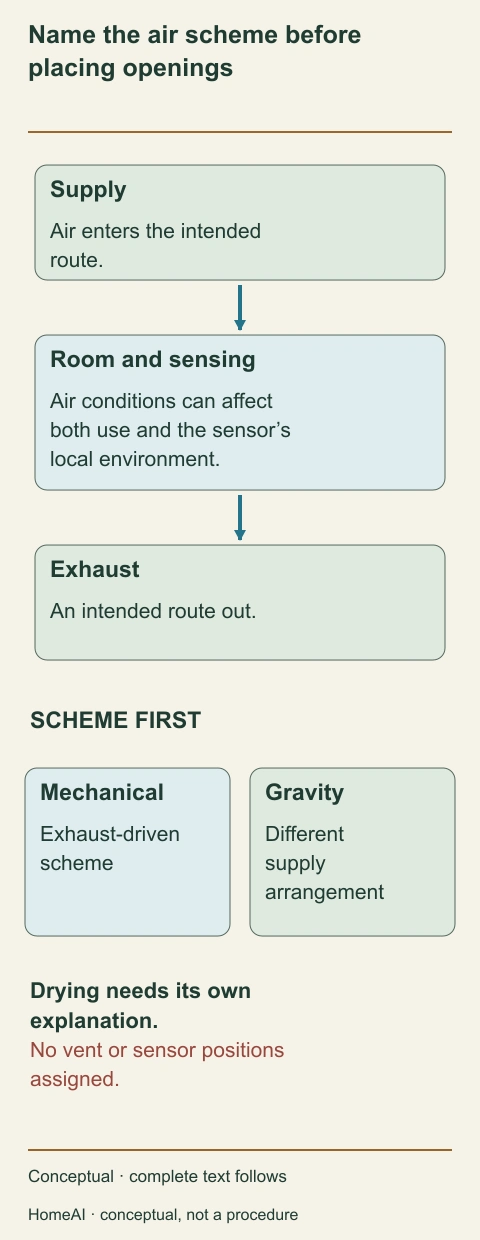
- Supply
Brings air into the intended room route.
- Room and sensor
Air affects both occupied conditions and the local sensing environment.
- Exhaust
Provides the intended route out.
- Drying
Needs its own post-use explanation; not every opening has the same job.
What does this illustration leave out?
Functional map only; no installed vent position, flow rate, diameter, fan or sensor-location design. This illustration explains an idea. It is not an installation guide.
Which scheme and complete sensor/air relationship do the actual instructions require?
Explore this with HomeAI ↗Opens an editable question. Nothing is sent until you choose to send it.Name the air scheme before placing openings
Supply, room, exhaust and drying have distinct jobs. Mechanical-exhaust and gravity schemes do not share one universal inlet placement or sensor relationship.
- Supply
- Brings air into the intended room route.
- Room and sensor
- Air affects both occupied conditions and the local sensing environment.
- Exhaust
- Provides the intended route out.
- Drying
- Needs its own post-use explanation; not every opening has the same job.
Figure scope: Functional map only; no installed vent position, flow rate, diameter, fan or sensor-location design.
A useful question: Which scheme and complete sensor/air relationship do the actual instructions require?
Full wording shown in this figure
- Name the air scheme before
- placing openings
- Supply
- Air enters the intended
- route.
- Room and sensing
- Air conditions can affect
- both use and the sensor’s
- local environment.
- Exhaust
- An intended route out.
- SCHEME FIRST
- Mechanical
- Exhaust-driven
- scheme
- Gravity
- Different
- supply
- arrangement
- Drying needs its own
- explanation.
- No vent or sensor positions
- assigned.
- Conceptual · complete text follows
- HomeAI · conceptual, not a procedure
How do the thermostat, timer and high-limit protection differ?
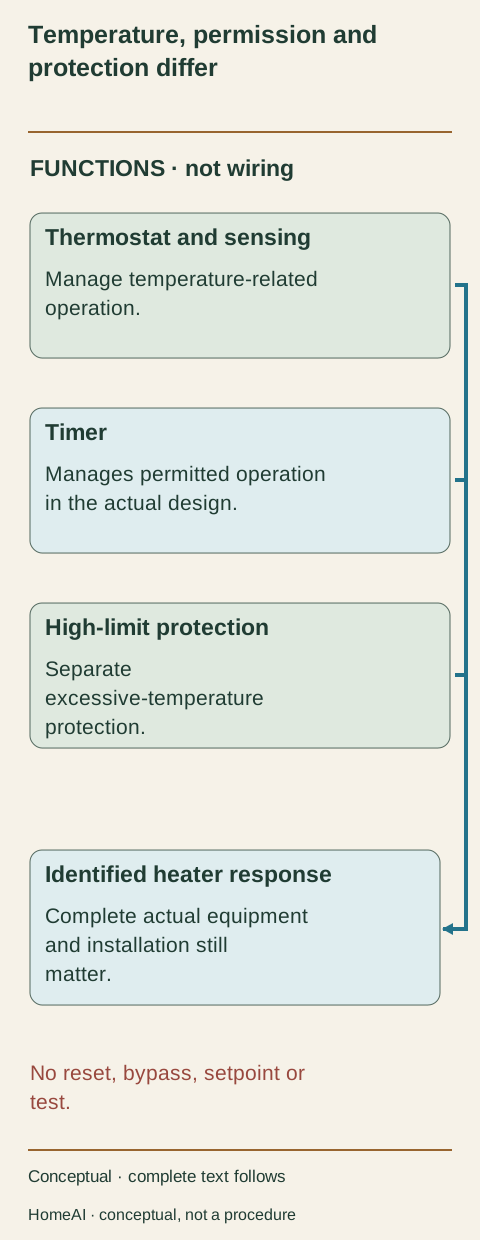
A thermostat manages temperature-related operation using the actual sensing and control arrangement. A timer manages the permitted operating period or scheduling function in the identified design. A separate high-limit protection responds to excessive temperature conditions at its own sensing arrangement. These are different jobs; a dial that changes a request does not redefine the protective function or certify room conditions.
The named KIP manual distinguishes built-in and separate-control variants, and its parts list includes a thermostat, timer, overheating limiter and contactor. A contactor is an electrical switching component controlled by another part of the system. The guide explains its job without supplying wiring or asking an owner to listen for a click, open a box or measure a live terminal.
Sensor location and incoming air can affect the local condition a controller sees. A displayed temperature is therefore meaningful only with its actual sensor, instructions and installation context. Do not compare two rooms by the dial numbers alone. Ask the provider what is sensed, what is displayed, which functions permit heating and how the system indicates a condition requiring service.
If protection operates, do not keep resetting it to complete a heat session. This article deliberately withholds the manual’s reset and component-test procedures. Obtain appropriate qualified assessment of the cause, actual protective components and any connected room or air concern. A successful reset or illuminated display is not a finding that the original condition has been resolved, and a protective function must never be bypassed.
Temperature, permission and protection differ
The thermostat manages temperature-related operation; the timer manages permitted operation, and a high-limit function supplies separate protection.
Numbers identify the parts explained below.
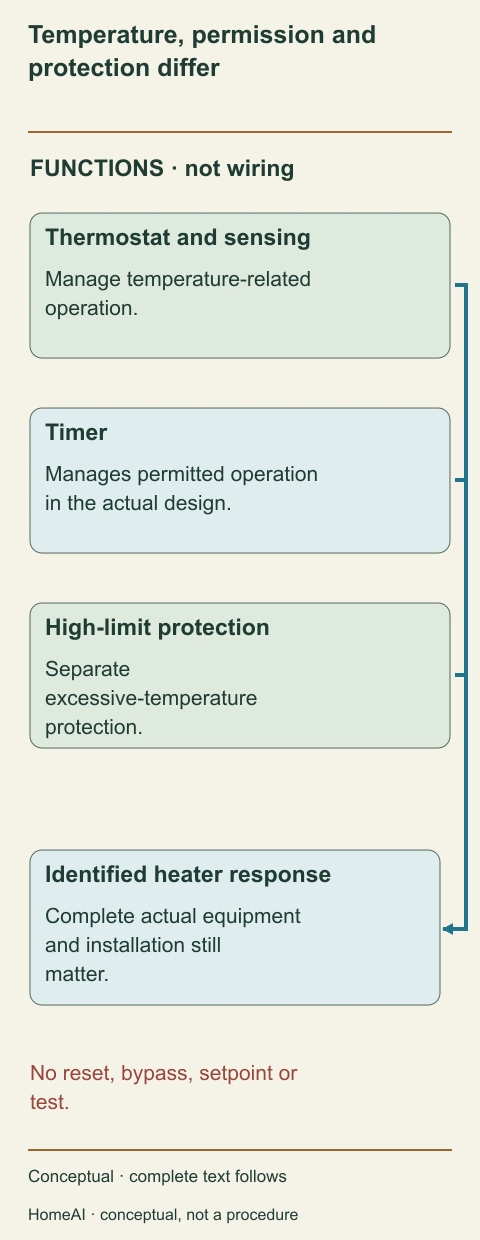
- Thermostat
Manages temperature-related operation.
- Timer
Manages permitted operation in the actual design.
- High-limit protection
Responds separately to excessive temperature conditions.
- Heater response
Depends on the actual complete equipment and installation.
What does this illustration leave out?
Function diagram, not electrical wiring, setpoint, reset, bypass or test instructions. This illustration explains an idea. It is not an installation guide.
Which control function was assessed, and what related room or air concern remains?
Explore this with HomeAI ↗Opens an editable question. Nothing is sent until you choose to send it.Temperature, permission and protection differ
The thermostat manages temperature-related operation; the timer manages permitted operation, and a high-limit function supplies separate protection.
- Thermostat
- Manages temperature-related operation.
- Timer
- Manages permitted operation in the actual design.
- High-limit protection
- Responds separately to excessive temperature conditions.
- Heater response
- Depends on the actual complete equipment and installation.
Figure scope: Function diagram, not electrical wiring, setpoint, reset, bypass or test instructions.
A useful question: Which control function was assessed, and what related room or air concern remains?
Full wording shown in this figure
- Temperature, permission and
- protection differ
- FUNCTIONS · not wiring
- Thermostat and sensing
- Manage temperature-related
- operation.
- Timer
- Manages permitted operation
- in the actual design.
- High-limit protection
- Separate
- excessive-temperature
- protection.
- Identified heater response
- Complete actual equipment
- and installation still
- matter.
- No reset, bypass, setpoint or
- test.
- Conceptual · complete text follows
- HomeAI · conceptual, not a procedure
Three controls answer three questions
- Thermostat and sensingJob: Manage temperature-related operationLimit: A displayed value is not every room or surface condition
- TimerJob: Manages permitted operation/scheduling in the actual designLimit: Does not establish correct air, stones or enclosure
- High-limit protectionJob: Separate excessive-temperature protectionLimit: No bypass, repeated reset or owner fault trial
Named KIP component example; no wiring, setpoint or reset procedure.
Why do the enclosure, door and room materials affect response?
The heater warms a real enclosure with surfaces and contents, not only an abstract air volume. The KIP manual relates heater selection to the room and its construction, including surfaces that take additional heat. Insulation and lining have different jobs, and an opening connects the room to adjoining space. Those relationships help explain why a changed room can behave differently with the same heater.
The native room diagram separates heat entering room air and surfaces from heat leaving through the enclosure and opening. It gives no assembly specification, capacity formula, insulation thickness or permissible material. A visible timber finish does not reveal every layer behind it. A photographed foil edge or a contractor’s material receipt cannot alone establish the complete installed heat, air and moisture-control arrangement.
Ask about changes since the original installation: additional glazing, moved benches, replacement door, changed heater or controller, and any altered ventilation. Those are useful history questions, not claims that every change is defective. A qualified scope should identify the actual construction and equipment relationship where it matters, including concealed work that remains unknown rather than inventing an original compliant design.
Do not increase a breaker, fit a larger heater or alter insulation because warm-up feels slow. The electrical supply, product selection, control response and room construction need appropriate coordinated assessment. The goal is a supported explanation and work scope. A larger input number does not by itself establish a suitable enclosure, correct sensor arrangement or acceptable use condition.
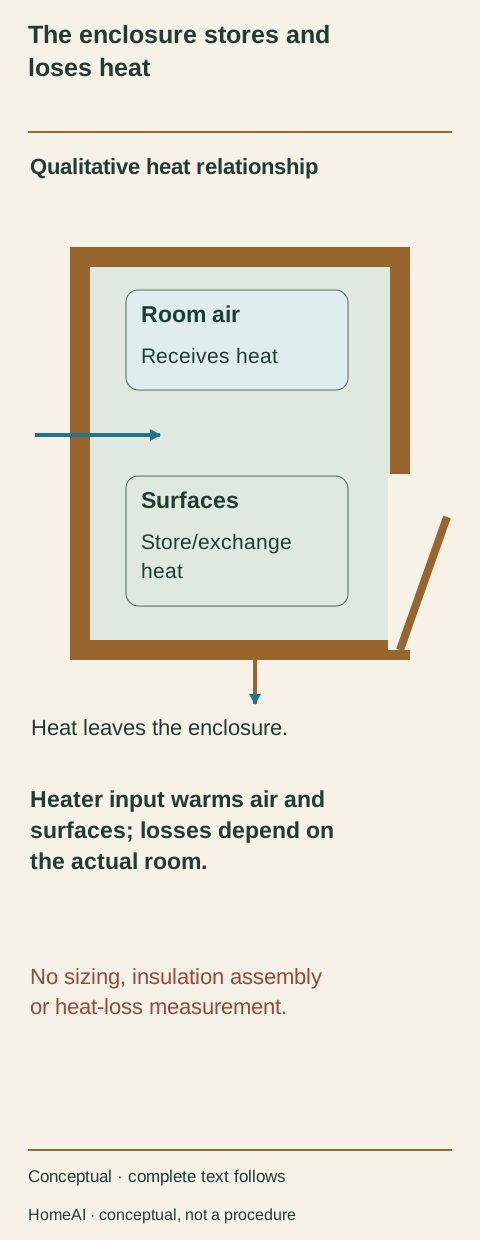
The enclosure stores and loses heat
The heater warms air and room materials while heat also leaves through the actual enclosure and opening. A room change can alter the assessment question.
Numbers identify the parts explained below.
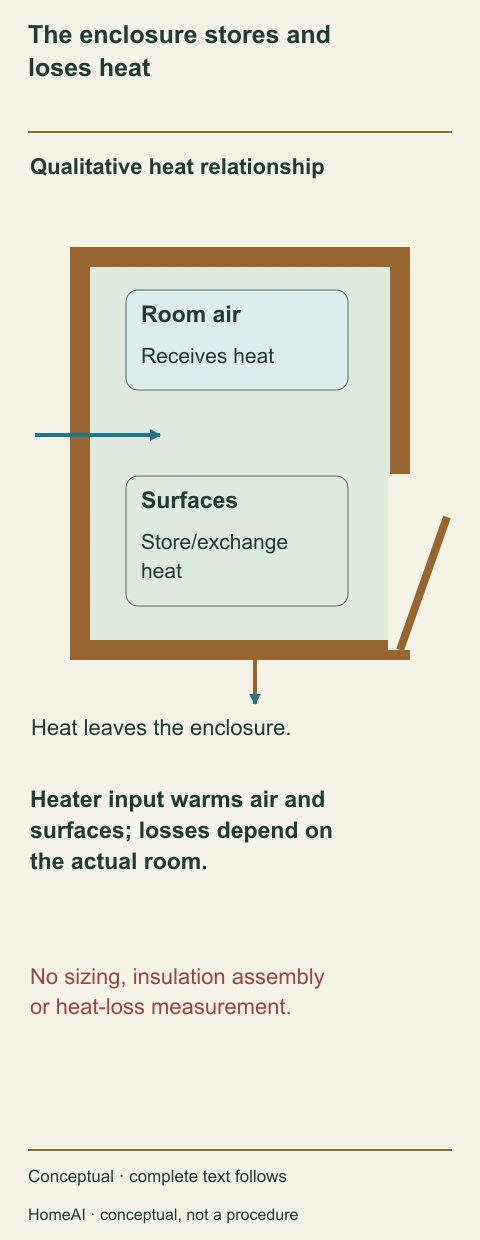
- Heater input
Adds heat through the identified equipment.
- Air and surfaces
Receive heat and respond differently.
- Enclosure
Has actual lining and concealed construction to identify.
- Door and changes
Connect the room to adjoining space and its history.
What does this illustration leave out?
No heat-loss value, sizing formula, insulation specification or building-assembly approval. This illustration explains an idea. It is not an installation guide.
Which enclosure changes were included in the assessment of the actual heater and room?
Explore this with HomeAI ↗Opens an editable question. Nothing is sent until you choose to send it.The enclosure stores and loses heat
The heater warms air and room materials while heat also leaves through the actual enclosure and opening. A room change can alter the assessment question.
- Heater input
- Adds heat through the identified equipment.
- Air and surfaces
- Receive heat and respond differently.
- Enclosure
- Has actual lining and concealed construction to identify.
- Door and changes
- Connect the room to adjoining space and its history.
Figure scope: No heat-loss value, sizing formula, insulation specification or building-assembly approval.
A useful question: Which enclosure changes were included in the assessment of the actual heater and room?
Full wording shown in this figure
- The enclosure stores and
- loses heat
- Qualitative heat relationship
- Room air
- Receives heat
- Surfaces
- Store/exchange
- heat
- Heat leaves the enclosure.
- Heater input warms air and
- surfaces; losses depend on
- the actual room.
- No sizing, insulation assembly
- or heat-loss measurement.
- Conceptual · complete text follows
- HomeAI · conceptual, not a procedure
Where does moisture go during use and drying?
Moisture added to sauna air needs an intended path out and an appropriate drying arrangement afterward. Where permitted water use creates vapour, that vapour joins air moving through the connected room. Surfaces and adjoining spaces are part of the moisture question. The manufacturer’s air guidance distinguishes ventilation during use from a separate drying function rather than treating every opening as the same device.
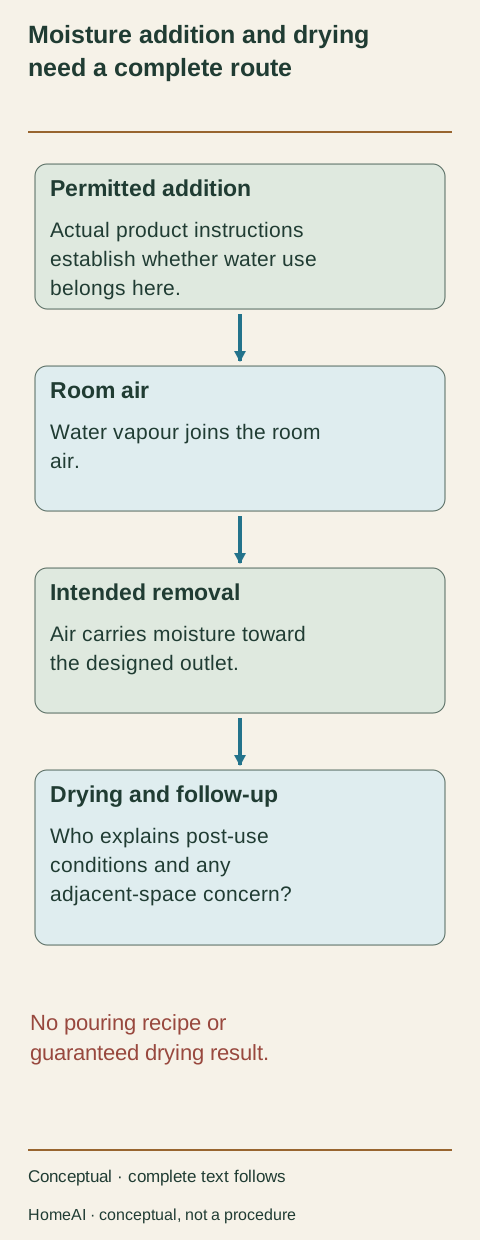
The native balance diagram follows addition, room exposure, removal and the later drying enquiry. It does not predict an indoor humidity, prescribe a fan or guarantee that mould cannot occur. The actual room, use and adjoining construction need their own assessment. A dry-looking timber surface at a showing does not establish what happens after repeated use, and a damp mark does not identify one cause by itself.
Describe existing observations and timing to the provider: where moisture was noticed, whether it followed use, what adjacent room was involved and what ventilation or drying routine was reported. Do not create extra steam, close vents or leave doors in an invented position to reproduce the concern. The applicable manual and qualified assessment determine the suitable investigation without exposing the home to an uncontrolled trial.
Keep heater service and moisture work distinct. An element replacement addresses a named heater task; it does not assess the enclosure’s concealed layers or exhaust destination. Conversely, a building-moisture scope may leave electrical controls outside its expertise. Ask the coordinated report to identify who covers each part and what remains unresolved before a cosmetic surface repair is treated as a complete answer.
Moisture addition and drying need a complete route
Where the actual product permits water use, moisture joins room air. Removal and post-use drying need an identified route and responsibility.
Numbers identify the parts explained below.
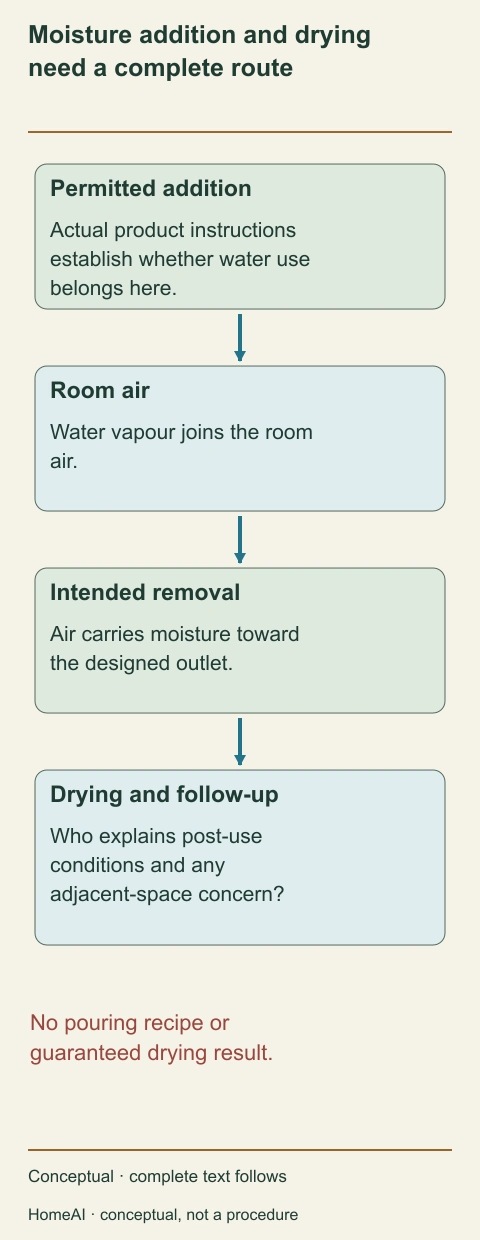
- Addition
Only the actual product instructions establish permitted use.
- Room air
Water vapour joins the room air.
- Removal
Air carries moisture toward the designed outlet.
- Drying follow-up
Condition and responsibility need their own explanation.
What does this illustration leave out?
No pouring, fan design, humidity target, condensation diagnosis or guaranteed drying result. This illustration explains an idea. It is not an installation guide.
Who explains the actual use and drying arrangement and any adjacent-space concern?
Explore this with HomeAI ↗Opens an editable question. Nothing is sent until you choose to send it.Moisture addition and drying need a complete route
Where the actual product permits water use, moisture joins room air. Removal and post-use drying need an identified route and responsibility.
- Addition
- Only the actual product instructions establish permitted use.
- Room air
- Water vapour joins the room air.
- Removal
- Air carries moisture toward the designed outlet.
- Drying follow-up
- Condition and responsibility need their own explanation.
Figure scope: No pouring, fan design, humidity target, condensation diagnosis or guaranteed drying result.
A useful question: Who explains the actual use and drying arrangement and any adjacent-space concern?
Full wording shown in this figure
- Moisture addition and drying
- need a complete route
- Permitted addition
- Actual product instructions
- establish whether water use
- belongs here.
- Room air
- Water vapour joins the room
- air.
- Intended removal
- Air carries moisture toward
- the designed outlet.
- Drying and follow-up
- Who explains post-use
- conditions and any
- adjacent-space concern?
- No pouring recipe or
- guaranteed drying result.
- Conceptual · complete text follows
- HomeAI · conceptual, not a procedure
What belongs in the electrical and installation enquiry?
The installed supply must suit the exact heater and control system under applicable local requirements. The KIP manual identifies variant-specific electrical arrangements and calls for qualified work. This guide gives no wiring, breaker size, conductor, bonding, disconnect or GFCI prescription. A foreign or older manual’s electrical statement is not automatically a current rule for a Canadian home.
Health Canada’s current electrical-product page explains Canadian certification marks for plug-in products and directs readers to provincial or territorial electrical safety authorities for further equipment-approval requirements. That is a useful identity and jurisdiction question, not a rule that all hardwired sauna equipment can be assessed by finding one familiar logo in an advertisement. Obtain appropriate verification for the actual installed product and use.
Request the heater and controller identities, applicable instructions, available installation and completed permit/inspection records, later change history and qualified service findings. Confirm with the responsible authority what is applicable locally. An issued permit and a completed inspection are different records, while neither supplies every later condition finding. Do not infer the status of concealed work from a tidy control faceplate.
If there is damaged electrical equipment, moisture at electrical parts, smoke, a burning concern or another immediate hazard, keep clear and obtain appropriate urgent assistance. Do not open a panel, inspect a live box or keep heating to collect more observations. Evidence gathering is useful only after safety takes priority; it is never a reason to remain beside a developing electrical or fire concern.
How do guards, benches, access and nearby objects affect ownership?
The heater’s hot surfaces and the room’s occupied routes need attention together. A guard separates people from the heater according to the actual design, while benches and the doorway organize access. Their existence in a photograph does not establish suitable dimensions, attachment, clearance or condition. The conceptual room image deliberately assigns none of those construction values.
Keep the heater free of stored items and follow the actual product’s restrictions. A towel, cleaning supply or later shelf changes what is near the heated equipment. A room arranged for storage between uses can create a different starting condition from the empty installation photograph. The household needs a reliable way to keep inappropriate objects out, without treating a timer or remote control as supervision.
Ask the provider to explain normal access, the actual stopping control and the response to an unexpected condition. Occupant needs and individual health considerations belong in the household plan. This article provides no child-use permission, emergency exit dimension, temperature tolerance or medical clearance. A working heater is not evidence that every visitor can safely use the room.
For inherited systems, arrange an authorized handover rather than a showing demonstration. A buyer or new owner need not sit in the room, touch hot surfaces or test a guard to ask useful questions. The equipment, enclosure, access and use responsibilities can be identified with the appropriate professionals while unfamiliar operation remains deferred. That produces better evidence than a reassuring brief heat cycle.
What can slow warming or a changed heat pattern mean?
A changed result can involve heat production, control, stone condition, air movement or the enclosure. Those are alternative paths, not a list of parts to replace in order. The named manual discusses heater and installation-related troubleshooting, while the current stones and ventilation bodies explain why airflow and sensing matter. A slow warm-up report does not identify a failed element by itself.
Describe the difference without an unsafe test: the room and setting normally reported, what changed, when it was first noticed, any recent work and any message already recorded. A display lighting up is an observation about the display. A contactor sound, perceived warmth or short service visit is not a complete measured explanation of the whole room’s response under actual use.
Ask a qualified provider to define the assessment of heater output and controls, then identify any air or enclosure scope requiring another specialist. The appropriate investigation may need permission, safe arrangements and access beyond an ordinary owner visit. This article supplies no live measurement, timer override, prolonged heating trial or hot-surface touch test, and no numerical promised warm-up time to compare against.
The report should connect its finding to the complaint. If it identifies an element issue and carries out heater work, ask what was checked afterward and which room questions remain. If no heater fault is found under the stated scope, that result still does not certify sensor placement, ventilation or concealed construction. A limited result is useful when its boundary leads to the next appropriate enquiry.
How should stone care, cleaning and service responsibilities be set?
Stones and heater openings are working parts of the heat-and-air arrangement. The manufacturer describes how stone condition and restricted spaces can affect that arrangement. Maintenance should follow the exact heater and stone instructions, appropriate cooling/isolation requirements and the provider’s scope. This article supplies no stone-rearrangement, impact test, material substitution, cleaning chemical or universal replacement interval.
Assign responsibility explicitly. Which tasks can the instructed owner perform under the actual manual, and which belong to qualified heater or electrical service? Who assesses a changing room surface or unexplained moisture? A general cleaning booking is not the same as a heater inspection. An electrician’s supply scope is not automatically a review of all enclosure details or individual health suitability.
Keep cleaning products and methods matched to the actual materials and instructions. Do not use the heater as a drying rack or operate it with covers, stored objects or exposed parts. The guide withholds the retained manual’s first-heating and smell statements rather than reassure a reader that an unusual smell is normal. Unexpected smoke or a burning concern calls for appropriate urgent action, not a scheduled maintenance note.
The service file should name model, concern, assessed parts, work, conditions of any functional assessment and remaining tasks. Preserve the original report, including its exclusions. A short summary can then say “heater work complete; room-air assessment pending” without inventing a successful whole-system handover. Useful maintenance makes the connected system more intelligible, not merely more recently invoiced.
Which identity, recall and change records belong in the file?
Keep separate identities for the heater, controller, sensor system where documented, and any infrared panels or later accessories. Match each to its applicable manual and installation date if established. A receipt dated when a house changed hands is not necessarily the equipment’s manufacture or installation date. A model list helps the next owner ask the right provider rather than guess from a photograph.
Check actual current recall information using those identities. Health Canada’s September 2026 notice illustrates why an exact model and affected scope matter. It does not mean every sauna is recalled, and this guide has not searched every possible product to provide an all-clear. If a product matches an active notice, follow its actual consumer action and contact instructions rather than continue using it because the room feels normal.
Add installation and completed records where available, later heater/control/ventilation or enclosure changes, service findings and the current handover. Keep source dates intact. The KIP manual’s 2023 printed identifier, the 2026 ventilation update and a particular local record answer different questions; combining them into one undated “approved instructions” file hides their useful limits.
Where a relevant record is missing, turn that gap into a defined task. Ask the responsible authority or appropriate specialist what can be verified now and what remains uncertain. Do not declare an installation lawful or defective solely from an empty folder. The purpose is to connect equipment, construction, actual condition and responsibility well enough to make an informed ownership decision.
Keep each piece of evidence attached to its question
- Heater/controller identityUseful question: Which instructions and notices apply?Limit: A similar family name does not establish an exact match
- Installation/completed recordsUseful question: What work and authority history is documented?Limit: Not every later condition is assessed
- Heater service reportUseful question: What finding and work are stated?Limit: Room, air, moisture and individual use may remain outside scope
No invented local code status or recall clearance; confirm actual applicable requirements.
How should you compare a repair with an altered room or replacement?
Compare proposals on the actual assessed need. An element repair, a ventilation review, a control replacement and an enclosure alteration are different scopes. They may be connected, but a price for one does not automatically include the others. Ask each provider to state which complaint and identified components the work addresses, and what evidence will support completion.
Do not assume a more powerful heater or a new controller is a simple upgrade. The complete supply, product compatibility, room and air/control relationship need appropriate assessment. Existing access for service and later replacement also matters. This guide gives no sizing formula, savings estimate, product ranking or resale premium; obtain current comparable proposals with their actual assumptions and local requirements.
If the intended use or installation cannot be supported, keep the sauna out of use while an appropriate alternative is arranged. That can mean further assessment, defined repair or a decision not to retain the amenity. Removal or conversion has its own electrical and building scope; it is not an owner disconnection lesson. A room’s decorative appeal does not remove those practical responsibilities.
Record the decision in ordinary language: the finding, chosen work, excluded questions, responsible providers and what must happen before any supported use. That record is more useful than “sauna upgraded.” It gives a future owner a route through the evidence and makes it harder for a limited completed repair to become an accidental claim that every connected system has been assessed.
How would a fictional owner resolve slow warming after a room change?
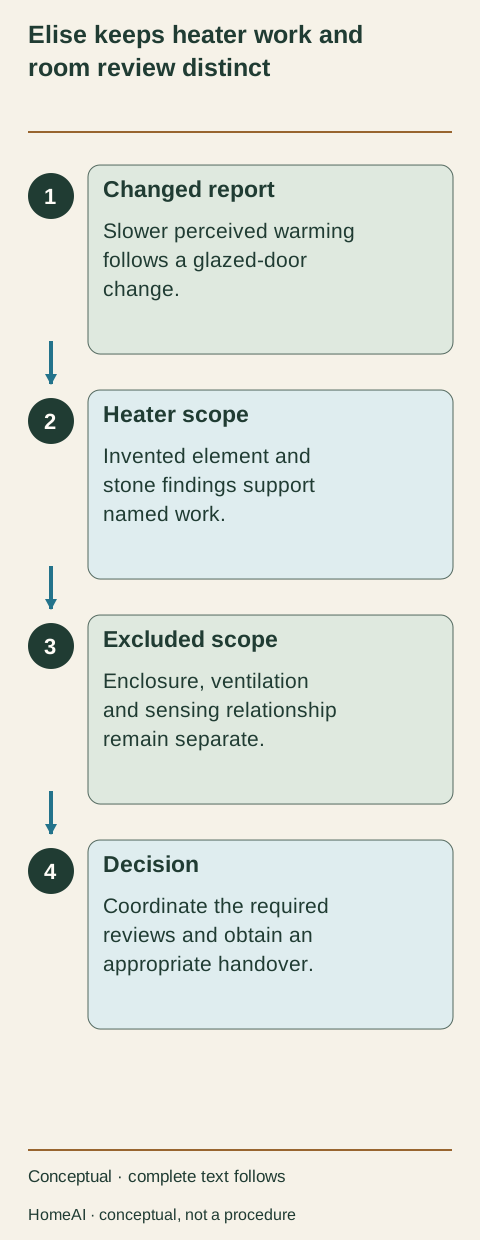
Fictional owner Elise reports that an invented electric stone sauna feels slower to warm after a larger glazed door was fitted. An old invoice only says “heater service,” and the inherited folder has no explanation of the air scheme. Elise does not increase a setting, block a vent or run a longer comparison trial. She arranges a defined heater-and-control scope and retains the door change as a separate history item.
In the invented report, the qualified provider identifies a failed element and an incorrectly matched stone replacement, then proposes model-specific heater work. Its scope explicitly excludes the enclosure alteration and ventilation design. Those are concrete fictional findings for learning; they do not diagnose a real product or prescribe a particular stone or repair. The report gives Elise a reason for the heater work without erasing the other questions.
Elise accepts the defined heater proposal and commissions an appropriate review of the changed room and actual air/sensor arrangement before relying on the system. The providers coordinate their boundaries and actual requirements. The new door is not declared the cause of the heater fault, and replacement of the failed component is not declared proof that the changed room is suitable. Both distinctions matter to the next decision.
The fictional outcome is a usable plan: resolve the identified heater work, reconcile the enclosure and air questions, retain the original reports and obtain the eventual appropriate handover. No temperature, warm-up time, installation approval, medical clearance or successful owner test is invented. A real household could receive different findings and choose a different repair or decide not to retain the installation.
Elise keeps heater work and room review distinct
The fictional provider identifies an element fault and incorrectly matched stones while excluding the door alteration and air design. Elise resolves those separate scopes.
Numbers identify the parts explained below.
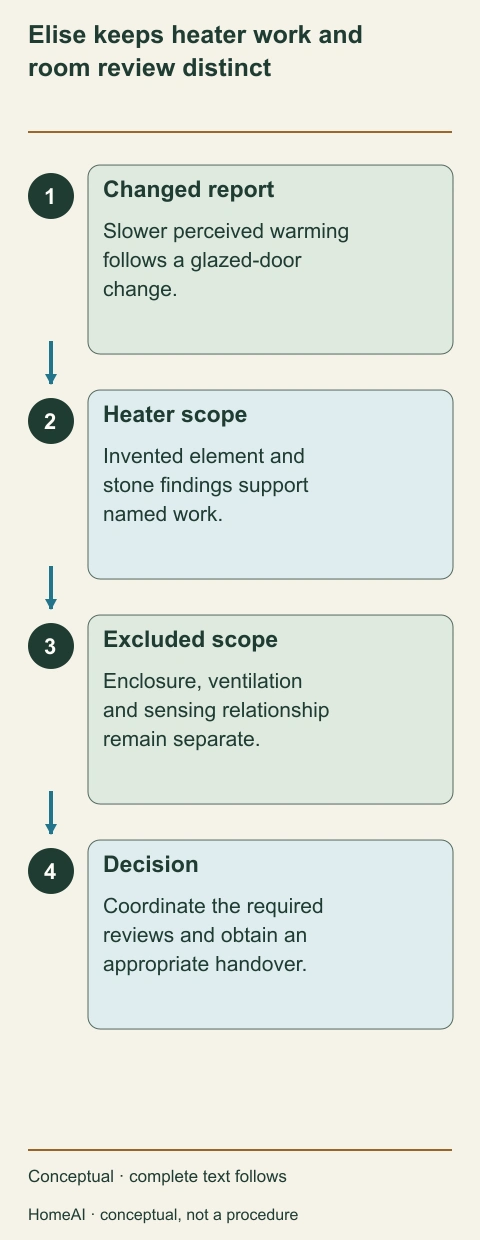
- Changed report
Slower perceived warming follows a glazed-door change.
- Heater scope
Invented element and stone findings support named work.
- Excluded scope
Enclosure, ventilation and sensing relationship remain separate.
- Decision
Coordinate the required reviews and obtain an appropriate handover.
What does this illustration leave out?
Fictional learning records; no actual repair, heating time, installation or medical clearance. This illustration explains an idea. It is not an installation guide.
Which identified work is justified, and which connected scope still needs a provider?
Explore this with HomeAI ↗Opens an editable question. Nothing is sent until you choose to send it.Elise keeps heater work and room review distinct
The fictional provider identifies an element fault and incorrectly matched stones while excluding the door alteration and air design. Elise resolves those separate scopes.
- Changed report
- Slower perceived warming follows a glazed-door change.
- Heater scope
- Invented element and stone findings support named work.
- Excluded scope
- Enclosure, ventilation and sensing relationship remain separate.
- Decision
- Coordinate the required reviews and obtain an appropriate handover.
Figure scope: Fictional learning records; no actual repair, heating time, installation or medical clearance.
A useful question: Which identified work is justified, and which connected scope still needs a provider?
Full wording shown in this figure
- Elise keeps heater work and
- room review distinct
- 1
- Changed report
- Slower perceived warming
- follows a glazed-door
- change.
- 2
- Heater scope
- Invented element and
- stone findings support
- named work.
- 3
- Excluded scope
- Enclosure, ventilation
- and sensing relationship
- remain separate.
- 4
- Decision
- Coordinate the required
- reviews and obtain an
- appropriate handover.
- Conceptual · complete text follows
- HomeAI · conceptual, not a procedure
What should a useful sauna handover make understandable?
The next user should be able to name the heater’s heat-producing elements, the stones’ storage role, the room’s surfaces and the intended air route. They should distinguish thermostat request, sensing, timed permission and protective limit. They should know which exact system is present and why an infrared cabin, electric stone heater and fuel-fired sauna cannot share one improvised instruction sheet.
Keep a concise handover with model identities, applicable manuals and their editions, local installation/completed records where applicable, current service findings, outstanding work and the appropriate contacts. Include the actual ventilation/drying explanation and cleaning responsibilities. The source file should preserve dates and original scope; the summary should help a reader find the evidence rather than replace it.
Before supported use, resolve unfamiliar equipment, unexplained protection operation, damaged parts, electrical or moisture concerns, changed construction and missing instruction through the appropriate providers. Keep objects away from the heater and do not bypass protection or copy a reset procedure from another model. Individual use and health questions remain separate from an equipment or building assessment.
The printable decision sheet asks: which heater and controls, which complete room/air arrangement, which findings and work, which unresolved scope, and who provides the handover? Actual answers and responsibility make it valuable. A generated room, a recent invoice or a checked box cannot certify the system. The goal is understandable connected ownership, supported by the actual product and current local requirements.
Keep learning about the connected parts
- Buying a home with a pool or hot tub: understand the system and handover
- Portable space heaters: follow the heat, controls and supply
- Why damp walls and mould keep coming back
- Can this home support your electrical plans?
- Inspecting a luxury or complex home: follow every connected system
Canadian context and authorities · Visual atlas · Learning labs
Practice the distinction.
Elise separates heater findings from the changed room
Clearly fictional learning case: slower reported warming follows a larger glazed-door change, and an old invoice only says heater service.
Reported observations
- The inherited folder does not identify the air scheme.
- A fictional defined heater report identifies an element fault and an incorrectly matched stone replacement.
- The scope excludes the enclosure alteration and ventilation design.
Compare the explanations
Expand each possibility to see the evidence needed to distinguish it. Similar symptoms can have different mechanisms.
The heater has a defined equipment concern
The invented report supports its named heater work, not an unlimited room approval.
Actual model, stated assessment, findings and work proposal.
Room, air and sensing questions remain separate
The door history and unknown air scheme need appropriate coordinated review without assuming either caused the element fault.
Change records and qualified review of the actual enclosure, air and sensor arrangement.
A useful next question
Elise commissions the defined heater work and the appropriate changed-room/air review, retains the separate reports and obtains the eventual handover before relying on the system.
Fictional learning findings; no actual temperature, warm-up time, electrical or building approval, clinical advice or owner diagnostic trial.
Know what the words mean.
- Sauna heating element
- The electrical heat-producing component in the identified heater.
- Sauna stone compartment
- The designed region that supports the heater’s specified stones and intended heat/air relationship.
- Heat storage
- Energy retained by warming material and later released; no duration or measured capacity is assigned here.
- Sauna thermostat
- The temperature-related control function in the identified sensing arrangement.
- Sauna high-limit protection
- A separate protective temperature function, distinct from the user’s normal comfort request.
- Contactor
- An electrical switching component controlled by another part of the identified system.
- Gravity ventilation scheme
- An air-movement arrangement relying on its designed non-mechanical driving conditions; not interchangeable with a mechanical-exhaust layout.
- Sauna drying function
- The intended post-use moisture-removal arrangement, which needs an actual system explanation.
- Infrared sauna panel
- A different product heating arrangement from a stone heater; applicable instructions and recall identity must be checked separately.
- Model-matched handover
- Instruction and evidence tied to the actual equipment, installation and responsibilities rather than a generic demonstration.
Questions to bring
to the conversation.
- Which heater, controller and matching instructions identify the actual system and later changes?
- Can the appropriate provider explain the complete heat, air, sensing and drying arrangement?
- Which heater, electrical, enclosure and moisture scopes were actually assessed?
- What work, original reports and instruction must be complete before supported use?
Separate a showing observation, an existing record and a new professional assessment. Unknown means a question remains; it does not automatically mean a defect.
Use the evidence planner ↗Go to the source.
Original HomeAI explanation informed by these public references. Sources support the underlying guidance; they have not reviewed or endorsed HomeAI. Diagrams are conceptual, and calculator outputs depend on your inputs.
Read October20,2026 in America/Edmonton. KIP printed2023 named manual, current January2026 manufacturer ventilation and undated stones body retain product/scheme limits; no universal Canadian electrical/building rule, air-change rate, vent position or clinical benefit. September2026 HC recall is exact-product scope, not all saunas or KIP. Worked household fictional.
Publication & source review
First published .
Sources reviewed .
Have a question about your home?
Start with the symptom, timing and what you have observed.
Ask HomeAI