Jump to a question in this guide
- What are you committing to before the condo exists?
- Identify the exact unit and every attached interest
- Read the agreement and disclosure as a connected package
- Distinguish the promised specification from the presentation
- Plan the deposit as a separate financial commitment
- Test future financing without assuming today's answer will hold
- Use dates as a network of obligations
- Separate permission to occupy from ownership
- Follow the unit and common elements on separate tracks
- Use the inspection to record condition and learn operation
- Understand assignment and exit questions before depending on them
- Follow the development as well as the individual suite
- Fictional case: Alex tests the gap between signing and closing
- Carry the record through registration, closing and ownership
- A presale purchase begins with the signed future-unit, specification and disclosure package; a model suite or rendering is not the complete promise.
- Reconcile deposit dates, confirmed later funding and other closing amounts; an early loan discussion does not guarantee completion-stage borrowing.
- Keep contractual milestones, any applicable interim occupancy, registered ownership, unit inspection and common-element follow-up on their distinct tracks.
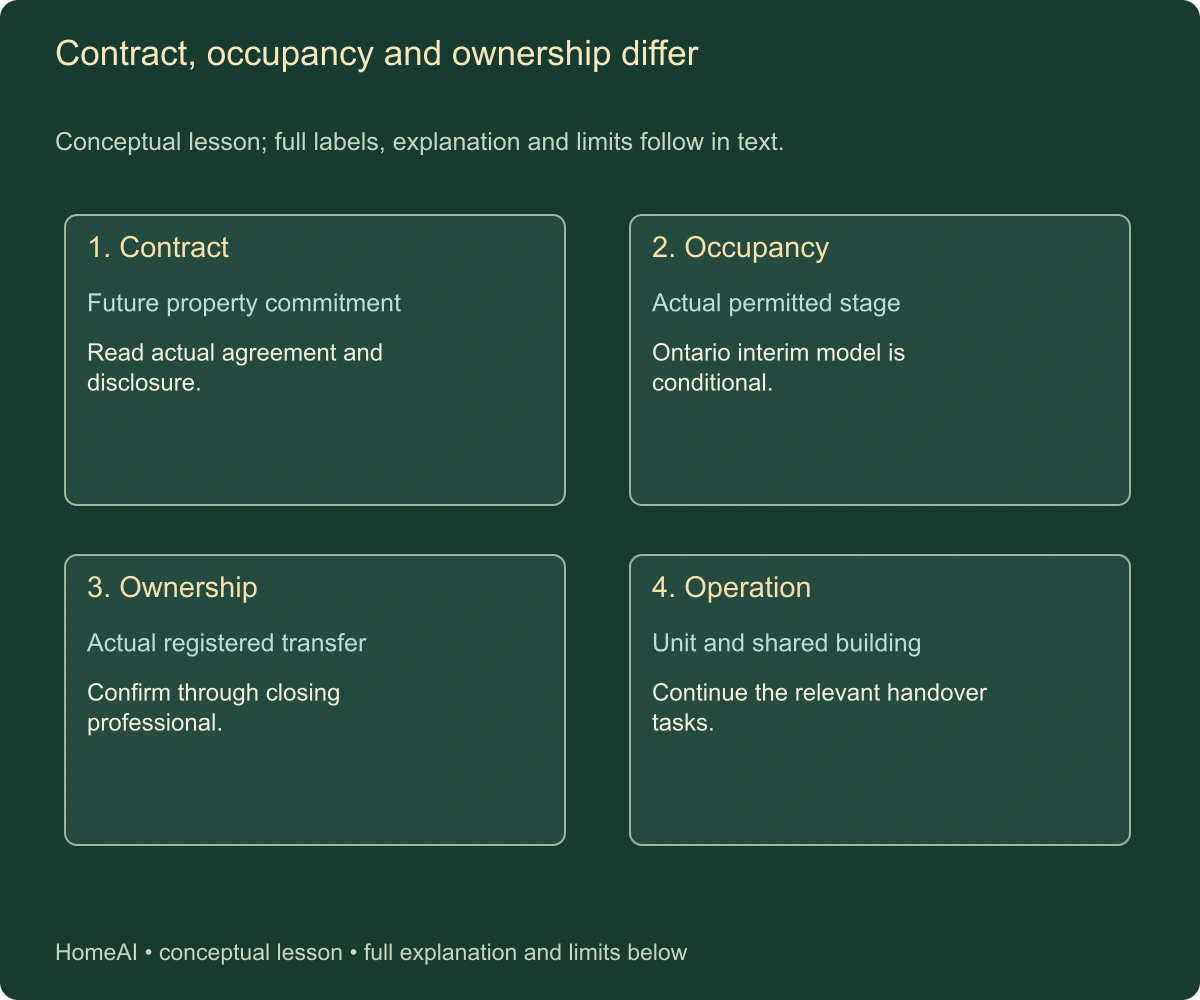
Stage boxes distinguish events; no unlabeled arrow promises automatic progression.
About this illustration
No actual project completion, title transfer, dates or nationwide interim model. This is a conceptual teaching model, not an assessment of your home.
7 picture lessons appear beside the questions in this guide. Use them to understand the explanation, then consider what it means for your home.
What are you committing to before the condo exists?
A precompletion condominium purchase asks a household to make decisions while the finished unit, registered property and operating building may still be in the future. A model suite and attractive rendering help describe an intention, but the actual commitment sits in the agreement and its incorporated documents. Begin with what is being promised, who is promising it and how the future property is identified.
The question differs from inspecting a completed resale condo. There may be no finished suite to walk through and no established operating history to review. The household must evaluate the agreement, specifications, development information, funding and timing while recognizing what remains uncertain. The later inspection and handover still matter; they cannot replace the earlier contract review.
This guide uses current complete bodies from BCFSA's consumer presale guide and CAO's preconstruction-condo page, with their British Columbia and Ontario scopes kept separate. Tarion's PDI page is addressed to builders in its Ontario program. All were read October 14, 2026; no undated page is assigned an invented revision date. The held CAO buyer-guide PDF and a separately blocked BCFSA page are not adopted.
No rescission period, deposit-protection cap, fee formula, compensation entitlement or contract-termination rule is applied here. Those questions need current jurisdiction-specific advice and the actual documents. A general illustration cannot establish that a development is authorized, financed, on schedule or covered by a particular warranty program.
The practical objective is a decision with explicit dependencies. The household should know what it can verify now, what it must monitor later and what happens if its own circumstances or the development change. A future purchase deserves a complete plan rather than treating signing day as the end of due diligence.
Contract, occupancy and ownership differ
Stage boxes distinguish events; no unlabeled arrow promises automatic progression.
Numbers identify the parts explained below.
- Contract
Future property commitment. Read actual agreement and disclosure.
- Occupancy
Actual permitted stage. Ontario interim model is conditional.
- Ownership
Actual registered transfer. Confirm through closing professional.
What does this illustration leave out?
No actual project completion, title transfer, dates or nationwide interim model. This illustration explains an idea. It is not an installation guide.
Which actual documents and qualified advice resolve the distinction?
Explore this with HomeAI ↗Opens an editable question. Nothing is sent until you choose to send it.Contract, occupancy and ownership differ
Conceptual lesson; full labels, explanation and limits follow in text.
- Contract
- Future property commitment. Read actual agreement and disclosure.
- Occupancy
- Actual permitted stage. Ontario interim model is conditional.
- Ownership
- Actual registered transfer. Confirm through closing professional.
- Operation
- Unit and shared building. Continue the relevant handover tasks.
Stage boxes distinguish events; no unlabeled arrow promises automatic progression.
What remains unknown: No actual project completion, title transfer, dates or nationwide interim model.
A useful question: Which actual documents and qualified advice resolve the distinction?
Identify the exact unit and every attached interest
Match the unit's contractual description to the current plans and schedules. Record the building or phase, floor, unit identifier and the documents that define its area and layout. A marketing name may be convenient, but it should not replace the description used in the agreement or the eventual registration documents.
Parking, storage and outdoor areas need their own enquiry. Ask how each is described, what interest or use right is promised, whether an allocation is fixed or may change and which documents explain it. A parking image in a brochure cannot establish ownership, exclusive use, charging permission or the suitability of a particular stall for the household's vehicle.
Compare the plan with the household's intended use. Note circulation, furniture, accessibility needs, work space and storage, while recognizing that a drawing is not a measured completed suite. A marketing area should not be silently treated as usable floor space under every measurement convention. Ask the developer and legal adviser how dimensions and tolerances are described in this agreement.
Include the surrounding relationships that affect the unit: nearby corridors, service rooms, outdoor space and planned phases. A rendering may omit neighbouring structures or future work. Ask which elements form part of the contractual promise and which are illustrative. This is a document question before it becomes a viewing question.
Keep a dated baseline set of the relevant plans and schedules. If later revisions arrive, the household can compare like with like and ask about actual differences. The goal is not to turn every line change into a dispute, but to avoid discovering at handover that everyone had been referring to a different version.
How do drawings and specifications describe the actual future unit
condo cutaway with fully closed utility cabinet and concealed connections; no contracted layout, unit boundary or equipment-performance proof.
Numbers identify the parts explained below.
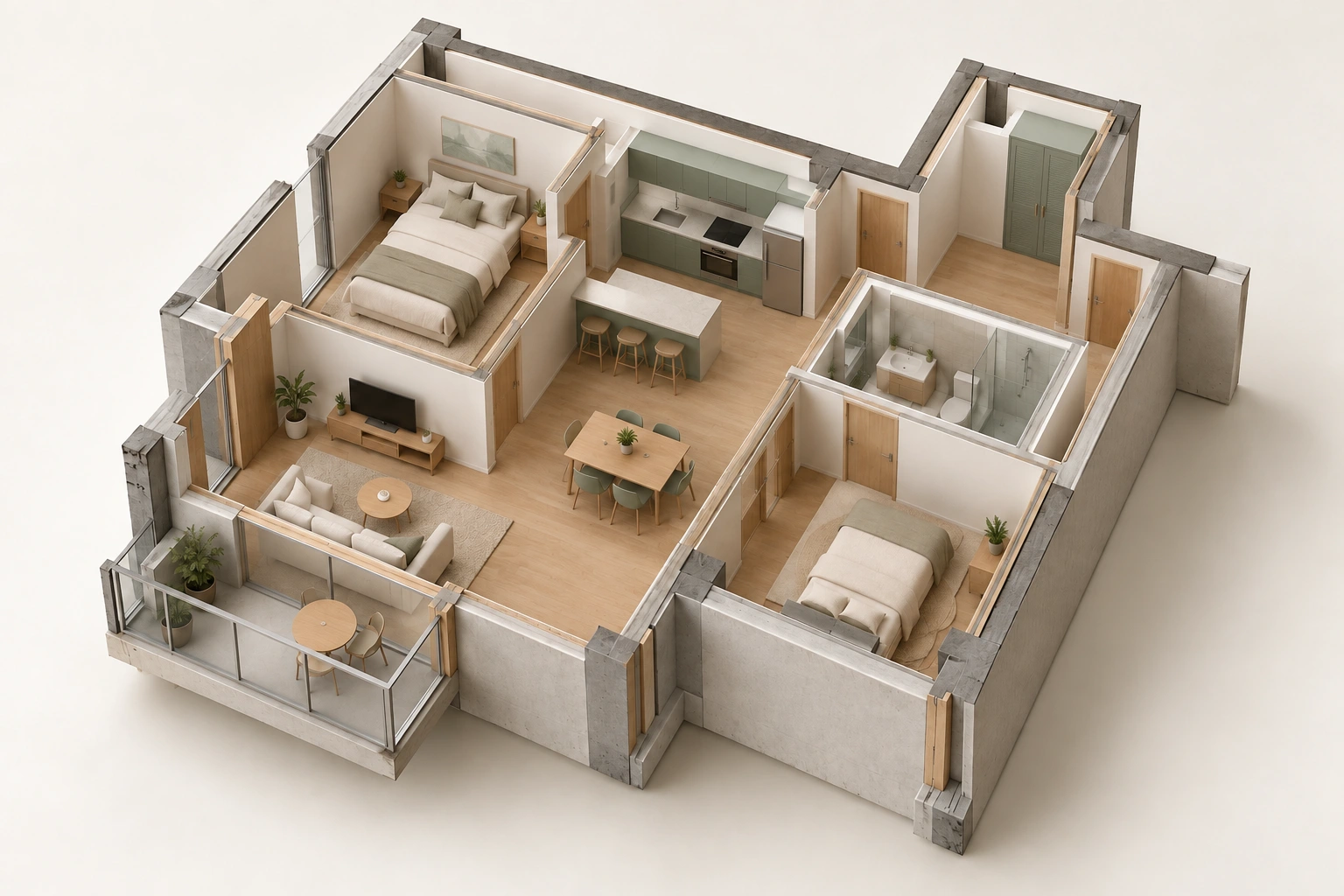
- Visible context
condo cutaway with fully closed utility cabinet and concealed connections; no contracted layout, unit boundary or equipment-performance proof.
- Limit
Conceptual generated context. No actual property, installed design, topology, measured performance, approval, ownership or responsibility established.
What does this illustration leave out?
Conceptual generated context. No actual property, installed design, topology, measured performance, approval, ownership or responsibility established. This illustration explains an idea. It is not an installation guide.
How do drawings and specifications describe the actual future unit?
Explore this with HomeAI ↗Opens an editable question. Nothing is sent until you choose to send it.How do drawings and specifications describe the actual future unit
condo cutaway with fully closed utility cabinet and concealed connections; no contracted layout, unit boundary or equipment-performance proof.
What remains unknown: Conceptual generated context. No actual property, installed design, topology, measured performance, approval, ownership or responsibility established.
A useful question: How do drawings and specifications describe the actual future unit?
Read the agreement and disclosure as a connected package
Collect the signed agreement, incorporated schedules, disclosure documents, addenda, specifications, selections and amendments in one index. Ask the legal adviser which documents govern and how conflicts between them are resolved. A brochure, salesperson's email and signed schedule may have different contractual significance; the household should not decide that hierarchy by visual polish.
The review should identify the parties, property, price, deposits, permitted changes, important dates, conditions, cancellation provisions, assignment terms and closing obligations. These are categories for professional review, not a substitute standard contract. Their precise meaning depends on the agreement, applicable legislation and current advice.
Ask who may give binding notices and how notices must be delivered. Keep contact information current through the authorized process. A household that changes address or adviser during a long project needs a dependable way to receive and review formal updates. Informal sales-office conversation may be useful context without satisfying a contractual notice requirement.
Treat unanswered questions as items to resolve before the relevant commitment or deadline. If a document is missing, identify it specifically rather than accepting a summary that everything is standard. A standard-looking form can still contain project-specific schedules and choices that materially affect this household.
The legal adviser should explain available rights and time-sensitive decisions for the actual province and transaction. Do not carry an Ontario interim-occupancy explanation into a British Columbia agreement or assume a rule from an older project remains current. This guide preserves the distinctions without calculating the reader's legal period or drafting a waiver.
Distinguish the promised specification from the presentation
Create a specification baseline for the items that matter: layout, finishes, appliances, fixtures, services and any selected options. Identify which description appears in the agreement or an incorporated schedule and which appears only in marketing. A model suite may contain upgrades, furnishings or details that are not included in the buyer's price.
Ask how selections become final and how substitutions or other changes are handled. The answer should identify the actual process, notice and contractual provisions rather than a verbal assurance that replacements will be equivalent. The legal adviser can interpret the relevant rights; an appropriate technical adviser can explain a proposed functional difference where needed.
For example, a household concerned about laundry, storage or cooking should check the promised arrangement and available dimensions rather than infer them from staging. The household can identify a practical need without assuming a particular brand, service capacity or installation route is guaranteed. An illustrative equipment cabinet does not establish an actual system design.
Maintain a change log with the earlier version, later version, date received, affected item and unresolved question. Keep the developer's explanation alongside the actual revised document. If a revision affects household suitability or financing assumptions, involve the relevant adviser promptly instead of waiting for the unit to be physically complete.
The objective is traceability, not a claim that every variation is prohibited or every substitution is harmless. A change may be permitted under the agreement, require advice or remain unclear. The household needs the actual answer and its consequences, while the original promise stays available for comparison.
Compare promise, revision and finished unit
Retain versions and ask what each establishes instead of treating a model suite as the contract.
Numbers identify the parts explained below.
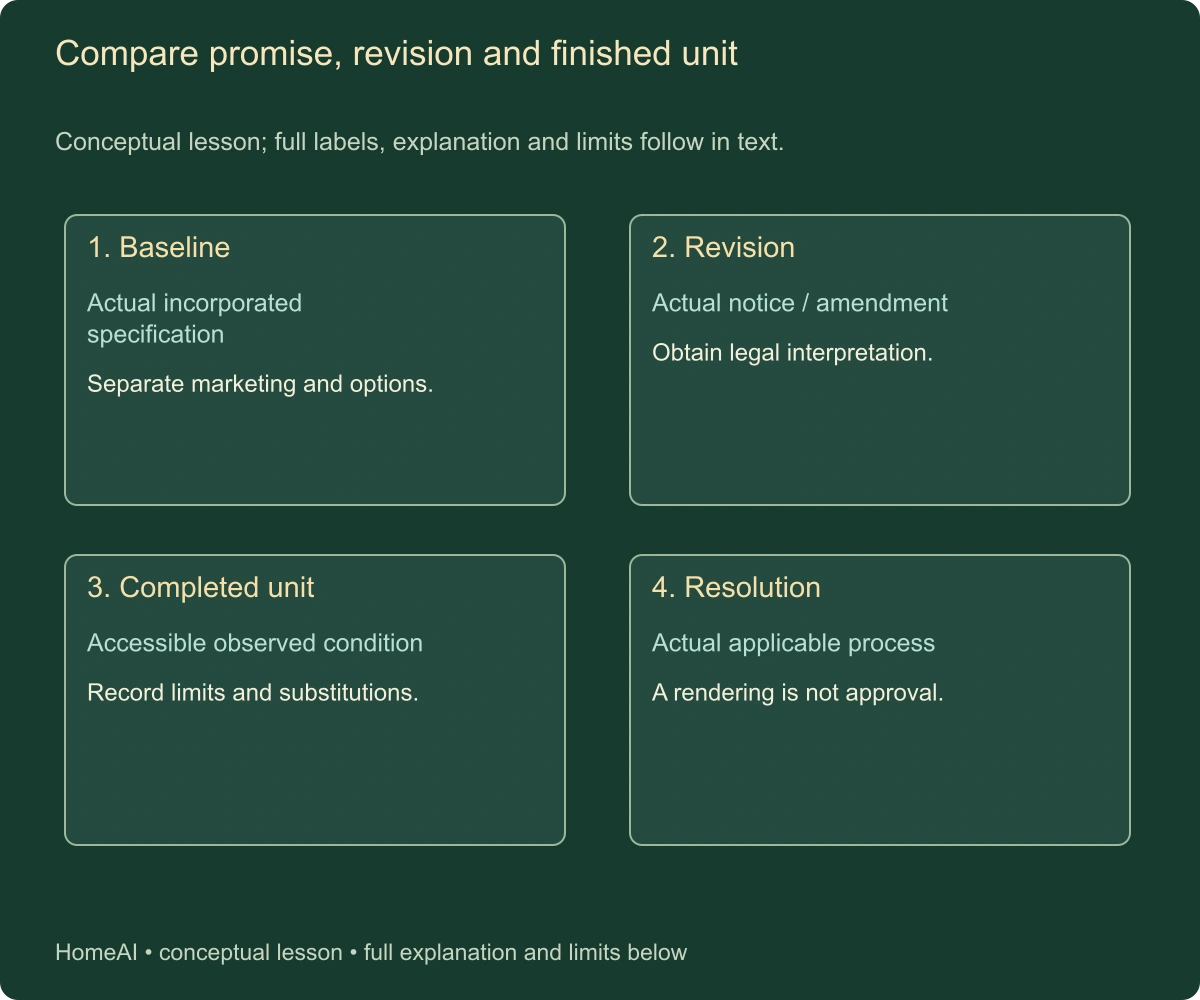
- Baseline
Actual incorporated specification. Separate marketing and options.
- Revision
Actual notice / amendment. Obtain legal interpretation.
- Completed unit
Accessible observed condition. Record limits and substitutions.
What does this illustration leave out?
No guaranteed layout, prohibited change or actual completion. This illustration explains an idea. It is not an installation guide.
Which actual documents and qualified advice resolve the distinction?
Explore this with HomeAI ↗Opens an editable question. Nothing is sent until you choose to send it.Which specified items, substitutions and actual completion records match
Kitchen finishes and balcony doorway in an architectural cutaway; no contracted product, dimension, substitution consent or specification proof.
Numbers identify the parts explained below.
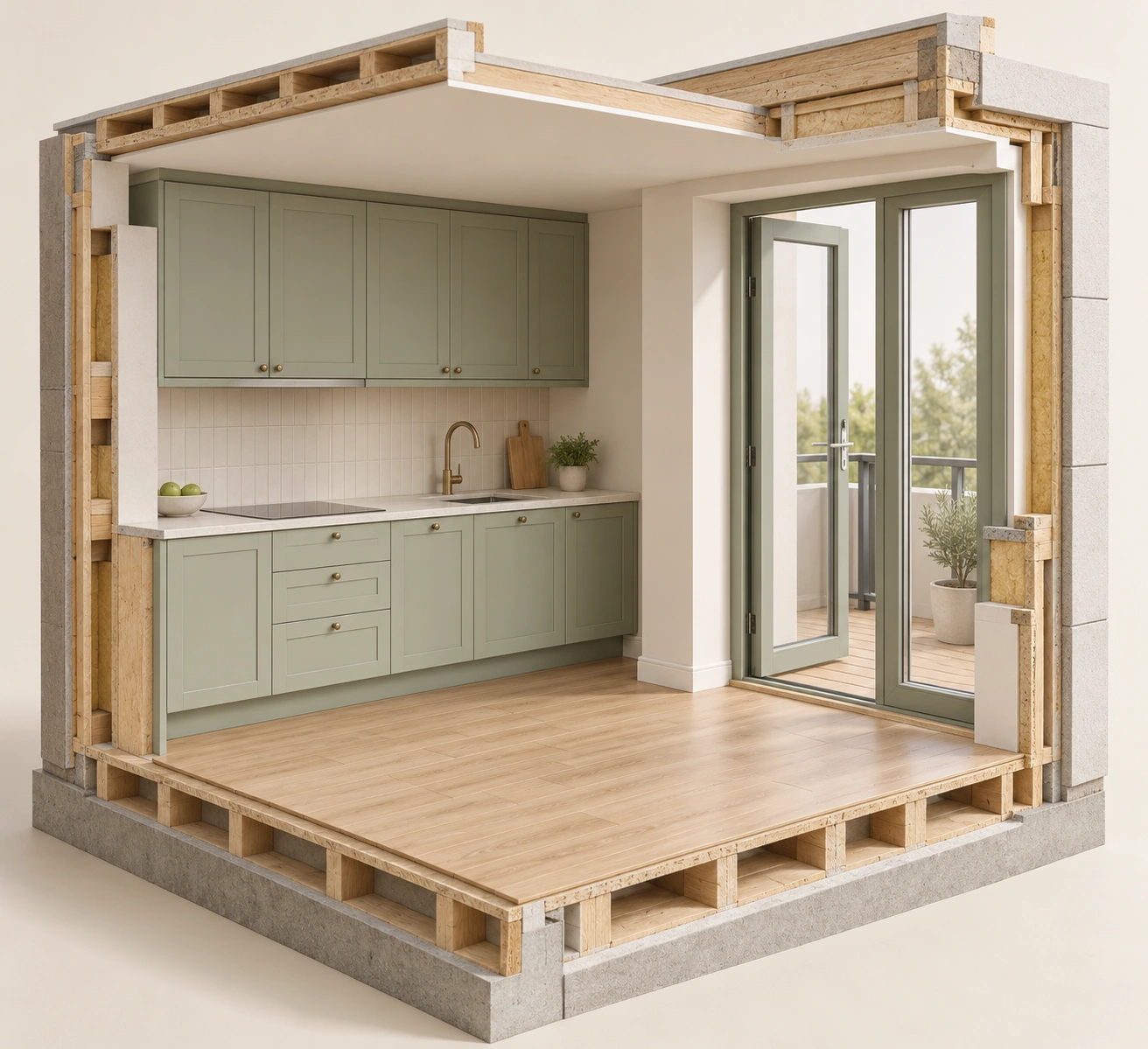
- Visible context
Kitchen finishes and balcony doorway in an architectural cutaway; no contracted product, dimension, substitution consent or specification proof.
- Limit
Conceptual generated context. No actual property, installed design, topology, measured performance, approval, ownership or responsibility established.
What does this illustration leave out?
Conceptual generated context. No actual property, installed design, topology, measured performance, approval, ownership or responsibility established. This illustration explains an idea. It is not an installation guide.
Which specified items, substitutions and actual completion records match?
Explore this with HomeAI ↗Opens an editable question. Nothing is sent until you choose to send it.Compare promise, revision and finished unit
Conceptual lesson; full labels, explanation and limits follow in text.
- Baseline
- Actual incorporated specification. Separate marketing and options.
- Revision
- Actual notice / amendment. Obtain legal interpretation.
- Completed unit
- Accessible observed condition. Record limits and substitutions.
- Resolution
- Actual applicable process. A rendering is not approval.
Retain versions and ask what each establishes instead of treating a model suite as the contract.
What remains unknown: No guaranteed layout, prohibited change or actual completion.
A useful question: Which actual documents and qualified advice resolve the distinction?
Which specified items, substitutions and actual completion records match
Kitchen finishes and balcony doorway in an architectural cutaway; no contracted product, dimension, substitution consent or specification proof.
What remains unknown: Conceptual generated context. No actual property, installed design, topology, measured performance, approval, ownership or responsibility established.
A useful question: Which specified items, substitutions and actual completion records match?
Plan the deposit as a separate financial commitment
List each required deposit, its contractual due date, recipient and documented handling arrangement. Confirm payment instructions through a trusted independent channel appropriate to the transaction. Keep receipts and the corresponding agreement provisions together so the household can reconcile what was required with what was actually paid.
Ask the legal adviser about the applicable trust and protection arrangements, including their limits and the circumstances relevant to this project. Do not assume every dollar, upgrade payment or assignment payment has identical treatment. The word protected is incomplete without identifying the actual arrangement and what it covers.
Money committed as a deposit may no longer be available for the household's ordinary emergency needs while the project proceeds. Build the household's cash plan around the actual payment schedule and other obligations. This is a budgeting consequence, not a prediction of interest, return or a legal entitlement to retrieve funds whenever circumstances change.
Keep deposit funds separate from the later mortgage enquiry. Paying a deposit does not approve the buyer, qualify the property or guarantee a loan at completion. Likewise, a lender's early discussion does not change the deposit obligations in the signed purchase agreement unless the actual arrangement provides for that relationship.
If an unexpected request for additional money arrives, compare it with the documents and seek appropriate advice before treating it as routine. A genuine project update and a changed payment obligation are different matters. The household needs authorized instructions and an understood basis rather than relying on urgency or a familiar-looking message.
Beside that deposit schedule, list amounts beyond the stated unit price that the actual documents and advisers identify. These may have different purposes, timing and treatment from deposits toward the price. Ask for an explanation of each applicable item rather than assuming that one advertised purchase number includes every amount required before ownership and ordinary operation.
Separate estimates from confirmed obligations in that column. A planning amount can help a household prepare, but its uncertainty should remain visible until the actual professional statement or provider terms are available. A change to an estimate does not by itself establish an improper charge, while a familiar label does not establish that the buyer must pay it. The agreement and current advice resolve the actual obligation.
Revisit the funding plan when selections, dates or other relevant terms change. A household might have adequate funds for the original schedule and a different constraint under an amended one. Keep the amounts and dates together, and ask the relevant adviser how the change affects the transaction. This avoids treating cash availability as a single yes-or-no answer established years before completion.
Test future financing without assuming today's answer will hold
The final borrowing decision may occur well after the household first signs. Income, debts, interest rates, lender criteria, property information and appraised value may change during that period. Ask the actual lender what an early approval or rate arrangement establishes, how long it applies and what must be confirmed again later.
Prepare a funding table for the contractual price, deposits already paid, remaining purchase funds and other closing amounts identified by the advisers. Keep confirmed sources separate from intended savings, a future sale or a proposed loan. A future source can be part of the plan without being described as currently available cash.
Consider a less favourable financing outcome as a household exercise. What if the available mortgage is smaller than expected or the monthly cost is higher? Use actual lender advice and the household's own figures rather than a generic stress rate. The exercise should show the additional funds or adjustment needed, not pretend to forecast market conditions.
BCFSA's presale guidance highlights the risk that later value and financing may differ from expectations. That is a reason to examine the household's capacity and the actual agreement, not a claim that the price will rise or fall. An inability to borrow does not automatically release the buyer from a purchase obligation.
Maintain contact with the lender as the development approaches its relevant stage. Provide accurate updates through the authorized process and ask what remaining property or borrower evidence is required. The developer's construction progress and the lender's approval are related to the transaction but remain separate decisions controlled by different parties.
Deposits and final borrowing differ
Payment, loan approval and available cash are separate dependencies in one household plan.
Numbers identify the parts explained below.
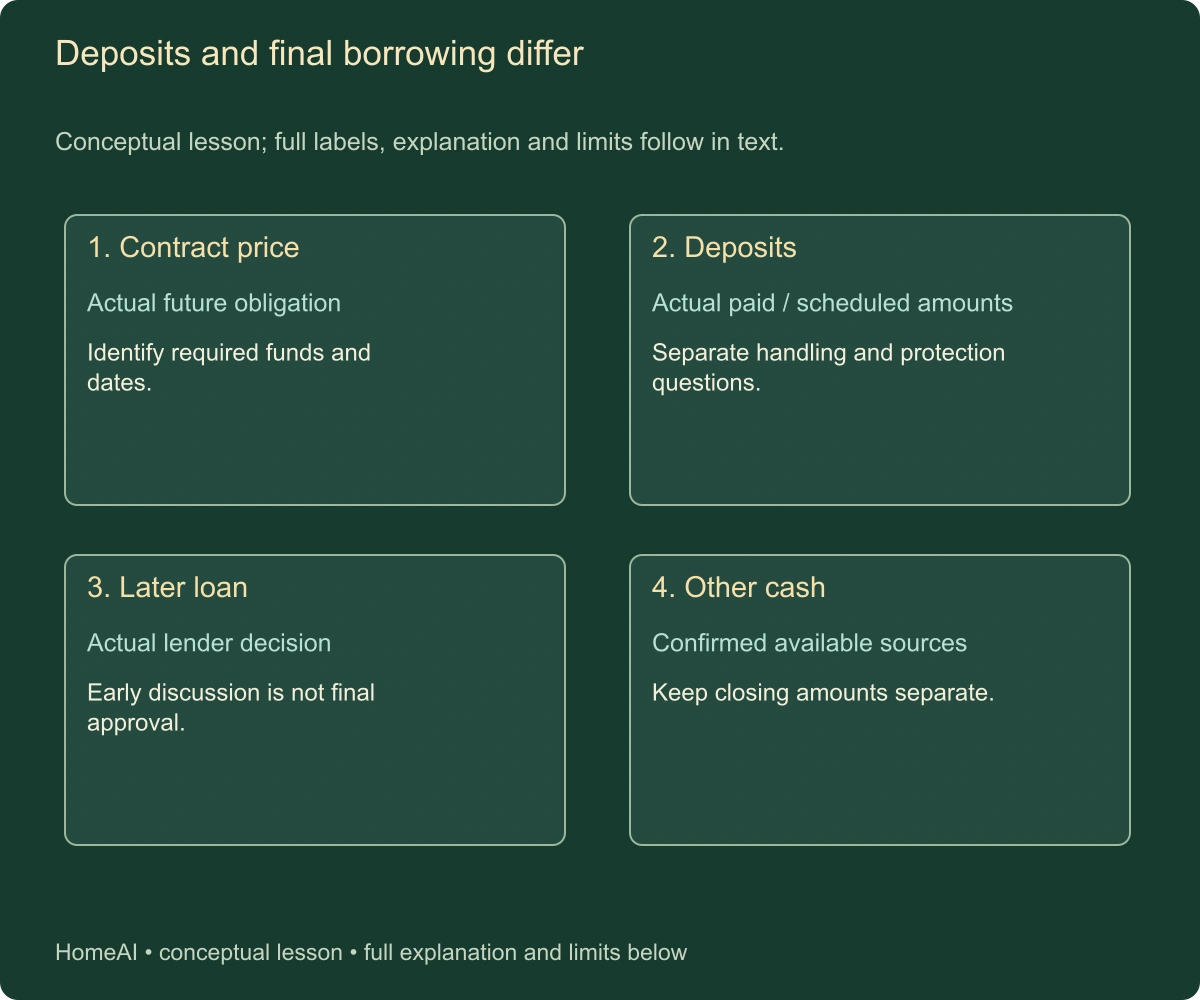
- Contract price
Actual future obligation. Identify required funds and dates.
- Deposits
Actual paid / scheduled amounts. Separate handling and protection questions.
- Later loan
Actual lender decision. Early discussion is not final approval.
What does this illustration leave out?
No protected amount, mortgage qualification, rate or closing-cost estimate. This illustration explains an idea. It is not an installation guide.
Which actual documents and qualified advice resolve the distinction?
Explore this with HomeAI ↗Opens an editable question. Nothing is sent until you choose to send it.Deposits and final borrowing differ
Conceptual lesson; full labels, explanation and limits follow in text.
- Contract price
- Actual future obligation. Identify required funds and dates.
- Deposits
- Actual paid / scheduled amounts. Separate handling and protection questions.
- Later loan
- Actual lender decision. Early discussion is not final approval.
- Other cash
- Confirmed available sources. Keep closing amounts separate.
Payment, loan approval and available cash are separate dependencies in one household plan.
What remains unknown: No protected amount, mortgage qualification, rate or closing-cost estimate.
A useful question: Which actual documents and qualified advice resolve the distinction?
Use dates as a network of obligations
Record the agreement's actual milestone dates and the documents that define them. Distinguish an anticipated construction milestone, a contractual occupancy date, a registration or closing stage and the household's own moving needs. A project update saying work is progressing does not automatically amend a date in the agreement.
The CAO page describes an Ontario addendum and critical-date framework. Its exact legal dates and remedies are not calculated here. The practical task is to have the adviser explain the applicable signed documents and identify which notices or changes need action. Other provinces and agreements require their own analysis.
Build a household contingency around the real dependencies: current accommodation, a home sale, storage, moving arrangements, work and school needs. Avoid committing to an inflexible move solely from a sales forecast. A contingency is not a prediction of delay; it acknowledges that an unfinished project can change timing.
Keep formal notices in date order, including how and when they were received and the professional advice obtained. If a notice raises a time-sensitive choice, ask promptly. The passage of a date on a generic planning sheet cannot establish a right to terminate, compensation or an extension in the actual agreement.
As completion approaches, confirm which date triggers which funds and actions. A buyer can understand a future unit and still be unprepared for the sequence of deposit, interim payment, loan advance and closing documentation. The dates need to connect with the funding plan rather than sit in a separate calendar nobody reconciles.
Separate permission to occupy from ownership
In the Ontario circumstances described by CAO, interim occupancy can occur before condominium registration and title transfer. The household may be able to use its unit while still awaiting ownership. This is a specific legal and transactional stage; it should not be generalized to every Canadian presale purchase.
Ask the legal adviser what the actual stage permits, what payment is required and what remains before final closing. Keep access, occupancy permission, registered ownership, mortgage advance and warranty processes distinct. Receiving keys can be important without proving that every one of those events has happened.
Budget the actual interim arrangement using the documents and professional advice. Do not assume an interim payment reduces the purchase balance or behaves like an ordinary mortgage payment. This guide does not calculate a statutory fee formula or decide whether a particular charge is lawful; those matters belong with the actual records and adviser.
Ask about practical operation during this stage: move-in booking, access routes, insurance responsibilities, building management contacts and areas still under construction. Answers should come from the authorized project parties and actual rules. A generic illustration of a completed corridor cannot establish which areas are available or what construction activity continues.
The household should receive a clear explanation of the next event that changes its status. Keep the closing professional's instructions and the developer's notices coordinated with the lender and insurer. A smooth move-in is useful, but the final ownership and funding steps still need their own completion evidence.
Follow the unit and common elements on separate tracks
A suite sits within a shared building. The contract and condominium documents define relevant boundaries, rights and responsibilities; visible location alone does not determine them. Windows, heating equipment, terraces and other features can raise questions that a room plan cannot answer by itself.
Tarion's builder-facing PDI page specifically reminds builders to distinguish unit inspection from common-element responsibilities in its program. The broader transaction lesson is to identify which party will inspect, report and pursue each concern. Do not assume the purchaser's suite walk-through covers the entire building or settles all shared-component issues.
Ask how the planned common areas and services relate to the household's use. Are the relevant access route, elevator, parking area and amenity part of the promised scope, and what is the stated completion stage? Keep current progress information separate from a contractual entitlement and from an authority's permission to use a particular area.
Early budgets and proposed rules are useful records but cannot supply a mature operating history that does not yet exist. Review their assumptions with the appropriate advisers and ask how updates will be communicated. A future building's actual expenses, maintenance experience and board decisions remain future matters rather than proven facts.
The existing condominium-reserve, insurance and building-system guides address later ownership questions. Here the handoff is explicit: preserve the development and unit records so the household can compare the promised arrangement with the registered and operating one. The transition to a condominium community deserves its own attention after the initial sale agreement.
How do unit completion and common amenities differ
Condo unit beside a common corridor and below an unfurnished terrace with closed door; no occupancy, legal boundary or amenity-completion proof.
Numbers identify the parts explained below.
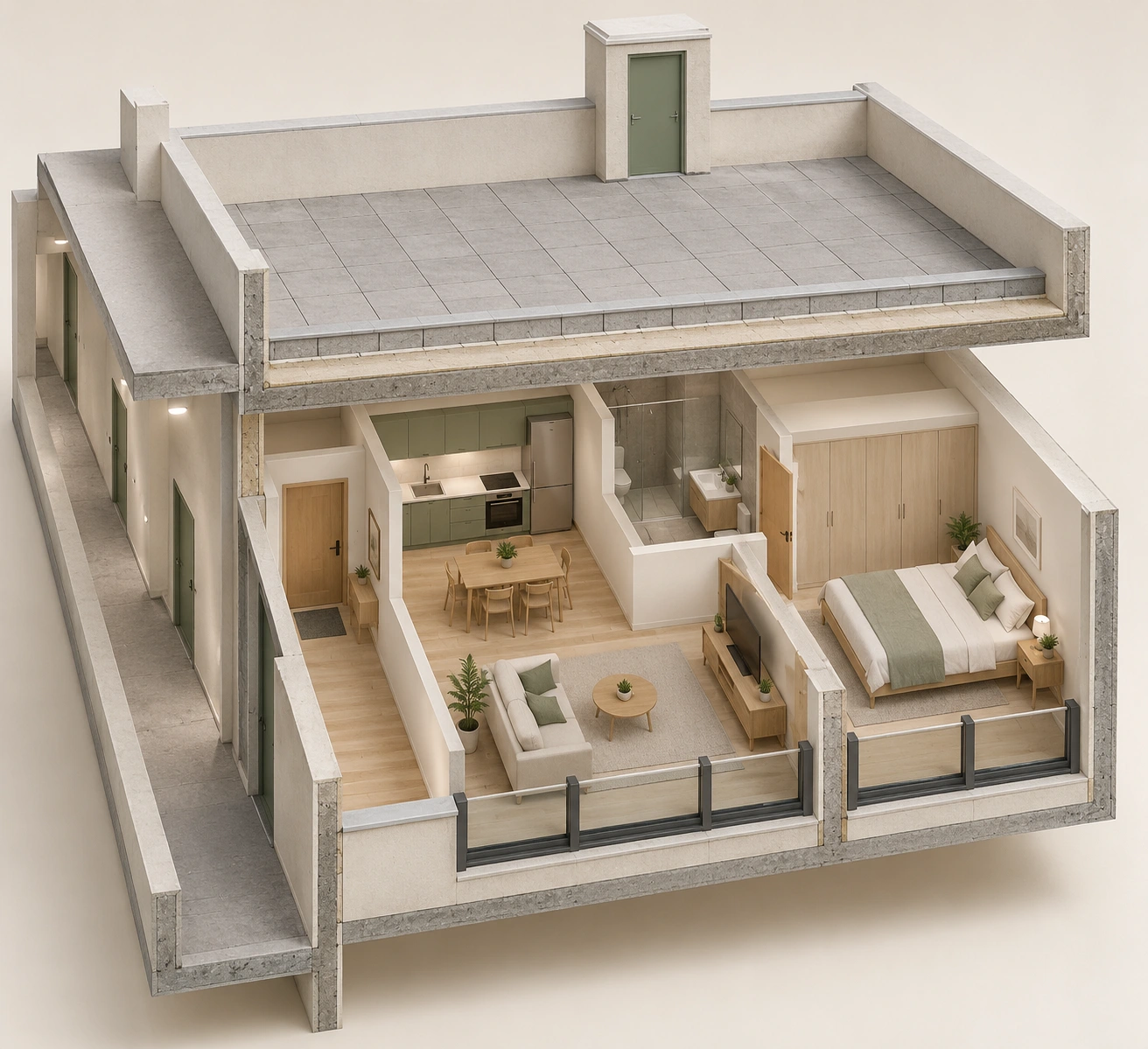
- Visible context
Condo unit beside a common corridor and below an unfurnished terrace with closed door; no occupancy, legal boundary or amenity-completion proof.
- Limit
Conceptual generated context. No actual property, installed design, topology, measured performance, approval, ownership or responsibility established.
What does this illustration leave out?
Conceptual generated context. No actual property, installed design, topology, measured performance, approval, ownership or responsibility established. This illustration explains an idea. It is not an installation guide.
How do unit completion and common amenities differ?
Explore this with HomeAI ↗Opens an editable question. Nothing is sent until you choose to send it.How do unit completion and common amenities differ
Condo unit beside a common corridor and below an unfurnished terrace with closed door; no occupancy, legal boundary or amenity-completion proof.
What remains unknown: Conceptual generated context. No actual property, installed design, topology, measured performance, approval, ownership or responsibility established.
A useful question: How do unit completion and common amenities differ?
Use the inspection to record condition and learn operation
Arrange the actual pre-delivery or handover inspection through the applicable program and project process. Confirm who may attend, what access will be available and how observations will be recorded. The household may want appropriate professional assistance, but attendance and authority to sign should be established under the actual requirements.
Tarion describes the PDI as a condition record and system orientation, and states that its form is not itself a warranty-service request. In its Ontario program, that distinction matters after the walk-through. A purchaser should understand the separate reporting process for unresolved items rather than assuming a list handed to the builder completes every later step.
Record the room, item and observed issue clearly. Include incomplete, damaged, missing, inaccessible or non-operating items as appropriate to the actual inspection scope. An inaccessible item should retain that status; it should not be marked satisfactory merely because the finished room looks orderly.
Compare the accessible completed unit with the relevant specifications and selections, and record apparent substitutions for the appropriate follow-up. The inspection does not by itself interpret every contractual change provision. Keep the condition enquiry and legal enquiry connected through the actual evidence while respecting their different professional roles.
Obtain operating instructions, relevant equipment information, contacts and copies of the signed records. Ask how an outstanding item will be tracked and where the household must report concerns afterward. A verbal intention to return next week is less useful than a clear record of the item, responsible party and applicable follow-up process.
Inspection, reporting and shared scope differ
Named Tarion process distinctions apply within its program; the actual condominium documents define component scope.
Numbers identify the parts explained below.
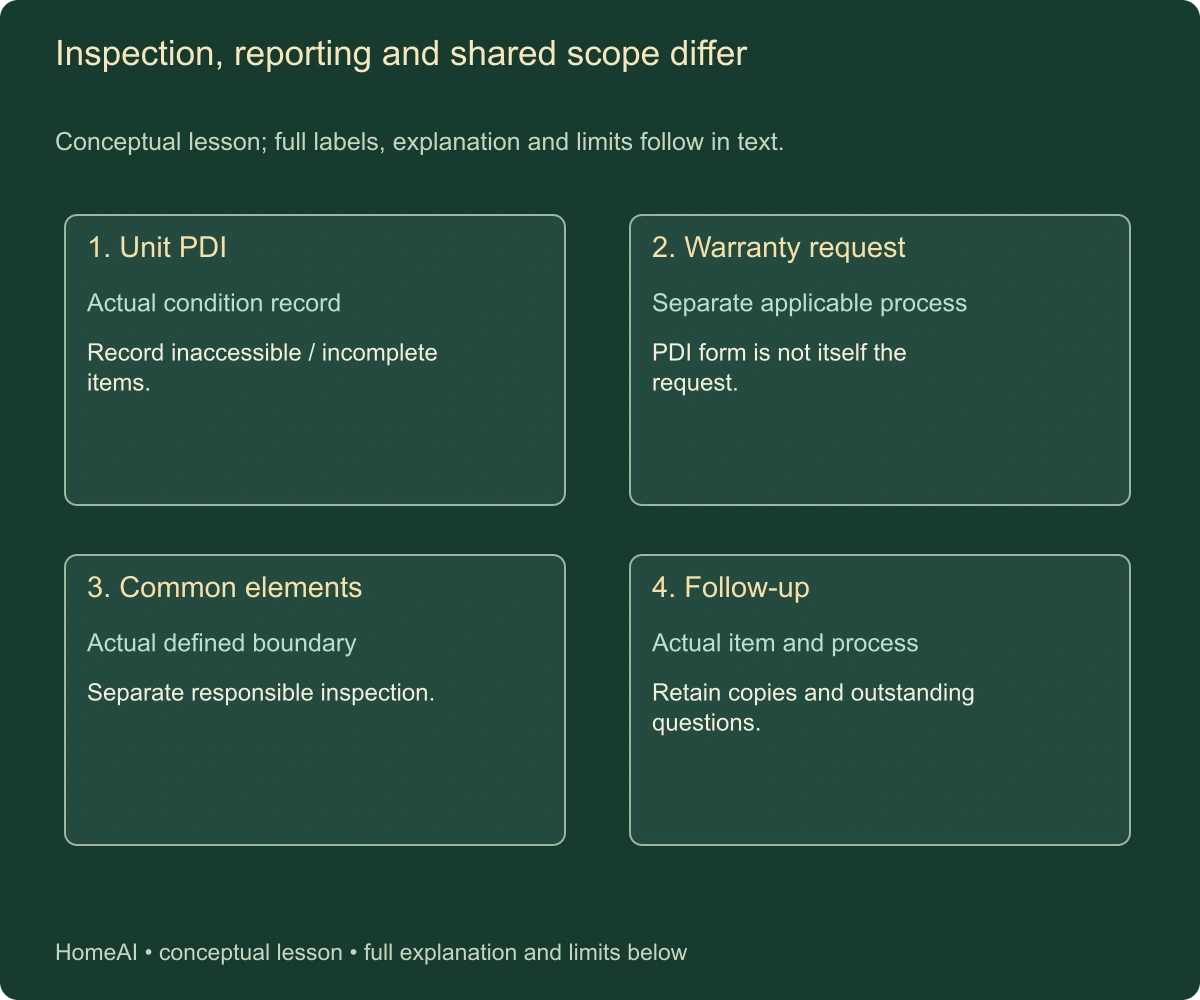
- Unit PDI
Actual condition record. Record inaccessible / incomplete items.
- Warranty request
Separate applicable process. PDI form is not itself the request.
- Common elements
Actual defined boundary. Separate responsible inspection.
What does this illustration leave out?
No universal warranty entitlement, resolved defect or complete building inspection. This illustration explains an idea. It is not an installation guide.
Which actual documents and qualified advice resolve the distinction?
Explore this with HomeAI ↗Opens an editable question. Nothing is sent until you choose to send it.Inspection, reporting and shared scope differ
Conceptual lesson; full labels, explanation and limits follow in text.
- Unit PDI
- Actual condition record. Record inaccessible / incomplete items.
- Warranty request
- Separate applicable process. PDI form is not itself the request.
- Common elements
- Actual defined boundary. Separate responsible inspection.
- Follow-up
- Actual item and process. Retain copies and outstanding questions.
Named Tarion process distinctions apply within its program; the actual condominium documents define component scope.
What remains unknown: No universal warranty entitlement, resolved defect or complete building inspection.
A useful question: Which actual documents and qualified advice resolve the distinction?
Understand assignment and exit questions before depending on them
A household's circumstances may change before completion. It may consider transferring the contract, seeking a permitted termination or another professionally advised option. None should be treated as a guaranteed escape route built into every presale purchase. Review the actual agreement and current jurisdiction-specific advice before relying on an option.
For an assignment, ask about developer consent, fees, restrictions, disclosure, taxes, financing and whether the original buyer retains obligations. The parties need legal and tax advice on the actual arrangement. An interested replacement purchaser or a higher advertised price does not itself complete a transfer or release the original buyer.
BCFSA's guidance flags that assignment can be restricted and that inability to complete can have serious consequences. This guide does not calculate liability or prescribe a legal result. The useful planning question is how the household would respond if a proposed assignment is unavailable, delayed or financially unattractive.
Keep an assignment analysis separate from marketing the property or contract. The authority to advertise, share documents, collect money and sign a transfer needs to be established. The household should not create promises to another buyer while its own right to transfer remains unresolved.
If a possible exit is linked to a project change or missed date, obtain advice promptly using the complete notices and contract. Do not assume a friend's experience on another development supplies the same right or period. The relevant decision belongs to this agreement, province and factual sequence.
Follow the development as well as the individual suite
The buyer's agreement concerns a future property within a wider project. Keep the unit's progress separate from the development's remaining stages and the information the developer is required or agrees to provide. An attractive finished suite does not by itself establish the state of parking, shared services, common areas or later phases.
Ask which current disclosure and project documents describe the development, the parties and the intended stages. Have the appropriate professional explain their significance and any amendments. A buyer is not expected to audit the developer's entire business from public marketing, and this guide does not declare a project financially sound or unsound from sales activity, visible construction or a lender's name.
The practical enquiry is about dependencies that affect the household's purchase and use. If the unit relies on access through an area still under construction, ask the authorized project parties about the actual arrangements and timing. If an amenity appears in marketing, ask where its promised scope and completion treatment are documented. Do not infer a right to immediate use from its appearance in an image.
Keep project updates with their source and date. A construction photograph can show activity at a location, while a formal notice may address a contractual stage. Neither should silently perform the other's job. If information conflicts, identify the conflict and ask the relevant adviser rather than creating a completion forecast from a collection of progress images.
Changes in surrounding phases can also affect the household's expectations of outlook, access or ongoing work. Review the actual disclosure and permitted-change provisions with the legal adviser. The buyer can ask whether its intended use still fits the documented arrangement without asserting that every nearby change is a breach or that every rendering guarantees a permanent view.
Finally, connect the development record to the later condominium record. The household should know where operating information, common-element concerns and board communications will be available as those arrangements emerge. Preserve the original promised scope and the relevant handover documents for comparison, while recognizing that future owners and the condominium will make decisions under their own authority. A complete presale plan reaches into that transition rather than ending when the sales office delivers a key.
Fictional case: Alex tests the gap between signing and closing
Alex considers a future condo for a fictional $600,000 contract price. The planned deposits total $120,000, leaving $480,000 of the price before other closing amounts. These figures are arithmetic for a decision example, not a mortgage approval, legal fee estimate, market forecast or recommended deposit structure.
Alex's initial financing plan anticipates a $450,000 loan and $30,000 of further cash toward that remaining price. The lender has not given a final completion-stage approval. If the eventual approved loan were instead a fictional $420,000, the price-only cash requirement would become $60,000: a $30,000 increase before any separately identified closing costs. The example predicts no actual lender outcome.
The unit plan includes a storage area and selected kitchen finish. A later project notice appears to change one of those descriptions. Alex records the versions and asks the legal adviser to review the actual change provisions, while the developer clarifies the intended specification. Alex does not decide from the rendering whether the variation is permitted or acceptable.
The anticipated move also depends on current accommodation. Alex creates a flexible timing plan and asks which signed date framework applies. If an Ontario interim-occupancy stage applies to the actual project, its payments and ownership status need separate explanation; Alex does not import that model into a different province merely because this example mentions it.
Alex's decision therefore has several live tests: contractual suitability, later funding capacity, specification clarification and moving contingency. A successful answer to one does not erase the others. Alex can seek more information or advice, adjust the plan or choose another purchase before making the relevant commitment; this fictional case supplies no actual entitlement to withdraw afterward.
Carry the record through registration, closing and ownership
Maintain one dated index from first agreement to final handover: signed documents, amendments, formal notices, plans, selections, receipts, lender instructions, inspection records, closing documents and operating information. Retain the original versions as well as later revisions so a future question can be traced without relying on memory.
Before the relevant closing stage, reconcile the professional statement of required funds with confirmed available sources and the actual payment instructions. Ask about unfamiliar adjustments or charges promptly. An earlier planning estimate is useful context, but the final transaction requires its own dated figures and professional explanation.
Confirm what evidence shows registration, ownership transfer and completion of the applicable funding steps. These are legal and professional processes; this guide does not instruct a reader to certify them from a sales-office update. Keep the completed documents delivered by the authorized professionals with the property record.
After occupancy, continue the relevant defect-reporting and warranty processes and learn the building's operating arrangements. A completed purchase does not automatically close every inspection item. Track each outstanding concern under the actual responsible party and process, while preserving the difference between unit and shared-building matters.
The household is prepared when it understands the future promise, the stages that change its position and the evidence required at each stage. The printable companion keeps those relationships available after signing. Built-in contextual images show generic spaces; native figures explain decision boundaries. Neither proves an actual project's completion, specifications, approval, ownership or financing.
Keep learning about the connected parts
- A new home needs a technical handover
- New-build commissioning: ask how the systems were verified
- Condo reserves: connect the money to the building
Canadian context and authorities · Visual atlas · Learning labs
Practice the distinction.
Fictional case: Alex tests the gap between signing and closing
Alex considers a future condo for a fictional $600,000 contract price. The planned deposits total $120,000, leaving $480,000 of the price before other closing amounts. These figures are arithmetic for a decision example, not a mortgage approval, legal fee estimate, market forecast or recommended deposit structure.
Reported observations
- Alex's initial financing plan anticipates a $450,000 loan and $30,000 of further cash toward that remaining price. The lender has not given a final completion-stage approval. If the eventual approved loan were instead a fictional $420,000, the price-only cash requirement would become $60,000: a $30,000 increase before any separately identified closing costs. The example predicts no actual lender outcome.
- The unit plan includes a storage area and selected kitchen finish. A later project notice appears to change one of those descriptions. Alex records the versions and asks the legal adviser to review the actual change provisions, while the developer clarifies the intended specification. Alex does not decide from the rendering whether the variation is permitted or acceptable.
A useful next question
Alex's decision therefore has several live tests: contractual suitability, later funding capacity, specification clarification and moving contingency. A successful answer to one does not erase the others. Alex can seek more information or advice, adjust the plan or choose another purchase before making the relevant commitment; this fictional case supplies no actual entitlement to withdraw afterward.
Know what the words mean.
- Presale agreement
- A contract concerning a future property, governed by its actual terms.
- Disclosure
- The relevant project information provided under the applicable framework.
- Specification baseline
- The actual documented promised layout, finishes and selected items.
- Assignment
- A proposed transfer under the actual consent, terms and legal advice.
- Interim occupancy
- The named Ontario stage before registration/title transfer in applicable circumstances.
- PDI
- The applicable pre-delivery condition record and system orientation.
- Common elements
- The shared property defined by the actual condominium documents.
Questions to bring
to the conversation.
- Which signed plans, specifications, parking/storage interests and change provisions define the property being promised?
- When is each deposit or other amount due, how is it handled, and what confirmed funds would be needed if later financing differs?
- Which date and occupancy/ownership framework applies, and who tracks specification changes, unit items and shared-building completion?
Separate a showing observation, an existing record and a new professional assessment. Unknown means a question remains; it does not automatically mean a defect.
Use the evidence planner ↗Go to the source.
Original HomeAI explanation informed by these public references. Sources support the underlying guidance; they have not reviewed or endorsed HomeAI. Diagrams are conceptual, and calculator outputs depend on your inputs.
Primary Canadian bodies read October 14, 2026 with recorded editions and jurisdiction limits. Historical sources and unread/access-held bodies are explicitly distinguished. Illustrations and fictional cases establish no actual condition, legal, health, coverage, financing or completion result. Actual documents and qualified advice control.
Publication & source review
First published .
Sources reviewed .
Have a question about your home?
Start with the symptom, timing and what you have observed.
Ask HomeAI